
How to Calculate Annual Salary: Formula & Examples

Alisha Anjum

Figuring out your true yearly income sounds simple until you actually try to do it. A paycheck stub shows an hourly rate or a bi-weekly deposit, but neither one tells you the full picture you need for budgeting, loan applications, or comparing two job offers side by side. That gap between what you get paid and what you actually earn each year causes real confusion, especially when raises, bonuses, or vacation days get added into the mix.
Knowing how to calculate annual salary clears up that confusion fast. Annual salary is simply your total gross pay for one calendar year, and you get there by multiplying your pay rate by the number of pay periods in a year. This article walks through that basic formula, shows you how to adjust it for holidays and vacation time, explains how to convert between weekly, bi-weekly, and monthly pay, and covers how to estimate what actually lands in your bank account after taxes.
By the end, you’ll be able to work out your own numbers with confidence, whether you’re paid hourly, salaried, or somewhere in between. Let’s start with the formula everyone from payroll clerks to HR software relies on.
Key takeaways
The core formula is gross pay per period multiplied by the number of pay periods in a year, whether you’re paid hourly, weekly, or monthly.
Unadjusted salary assumes you work all 260 days a year, while adjusted salary subtracts paid holidays and vacation days for a more honest number.
Weekly, bi-weekly, semi-monthly, and monthly paychecks all trace back to the same annual figure, just divided differently.
Gross salary is not take-home pay. Federal tax, FICA, and state withholding typically remove 15% to 25% before the money reaches you.
A free browser-based calculator, like the one on Tools Repository, can run every version of this math instantly without asking for your personal pay details.
Table of Contents
- What is the basic formula for calculating annual salary?
- How do you adjust annual salary for holidays and vacation days?
- How do you convert between pay periods?
- How do you compare job offers with different pay structures?
- How do you estimate take-home pay from your annual salary?
- Calculate your exact salary instantly with a free tool
- The takeaway
- Frequently asked questions
What is the basic formula for calculating annual salary?
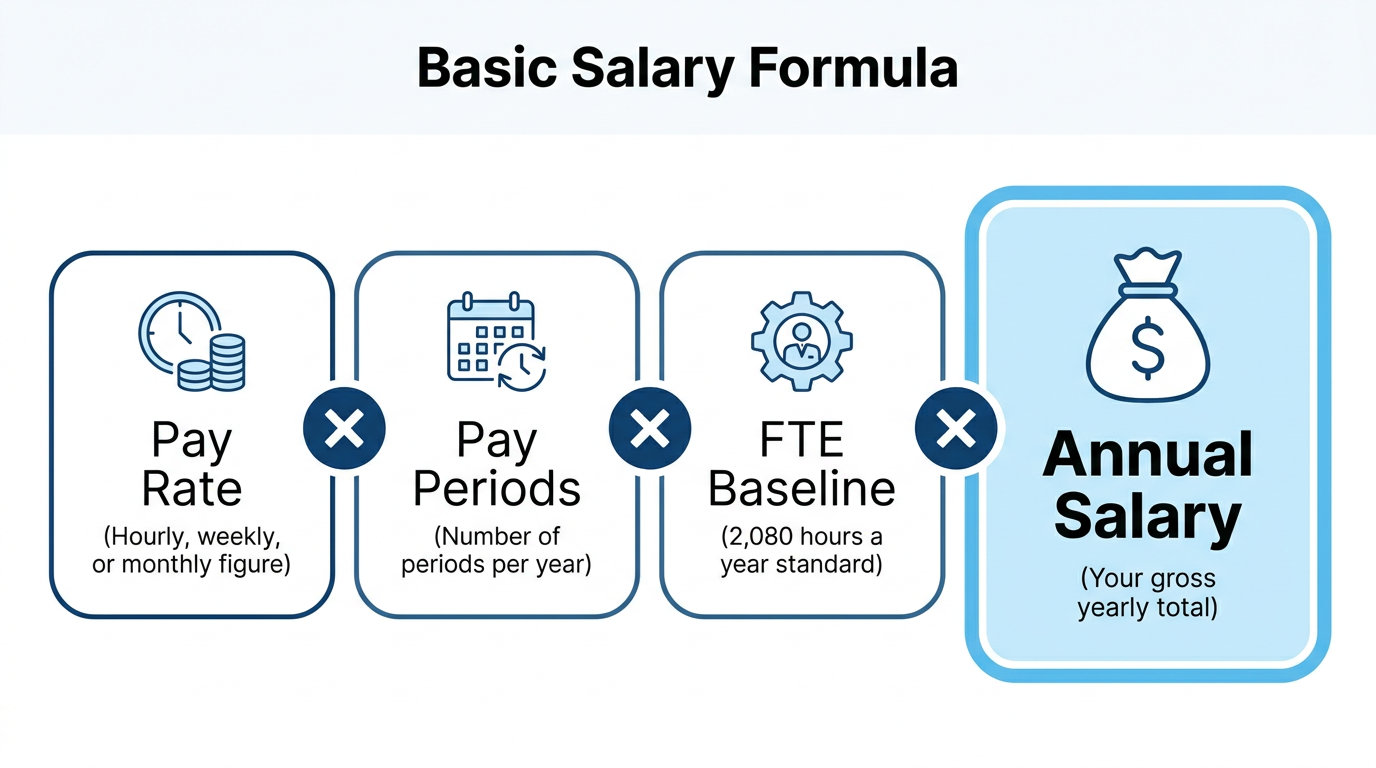
The basic formula for calculating annual salary is your gross pay per period multiplied by the number of pay periods in a year, and this single equation covers almost every pay type you’ll run into. If you’re paid hourly, that means hourly rate times hours worked per week times 52 weeks. If you’re on a weekly paycheck, it’s weekly pay times 52. Monthly earners multiply their monthly figure by 12. This math rests on a standard baseline most employers and payroll systems use, called a Full-Time Equivalent, or FTE, which is 40 hours a week for 52 weeks, adding up to 2,080 working hours a year. That baseline matters because every salary calculator, HR spreadsheet, and offer letter builds from it before anyone thinks about holidays, overtime, or part-time schedules. Once you know your pay rate and your typical hours, you have everything you need to work out a rough annual number in under a minute, and that number becomes your reference point for every other calculation in this guide, from comparing job offers to estimating your real take-home pay.
Examples for hourly, weekly, and monthly pay
Seeing the formula applied to real numbers makes it much easier to plug in your own figures later. Someone earning $25 an hour on a standard 40-hour week lands at $25 times 40 hours times 52 weeks, which comes to $52,000 a year. A worker paid $1,500 weekly reaches $78,000 annually simply by multiplying that figure by 52 pay periods. Someone on a $4,000 monthly salary ends up at $48,000 a year after multiplying by 12 months.
It’s worth noting that all three of these results are unadjusted figures. They assume you work every single scheduled day of the year without subtracting holidays or vacation time, which is the next piece of the puzzle worth understanding before you compare it to your own paycheck.
How do you adjust annual salary for holidays and vacation days?
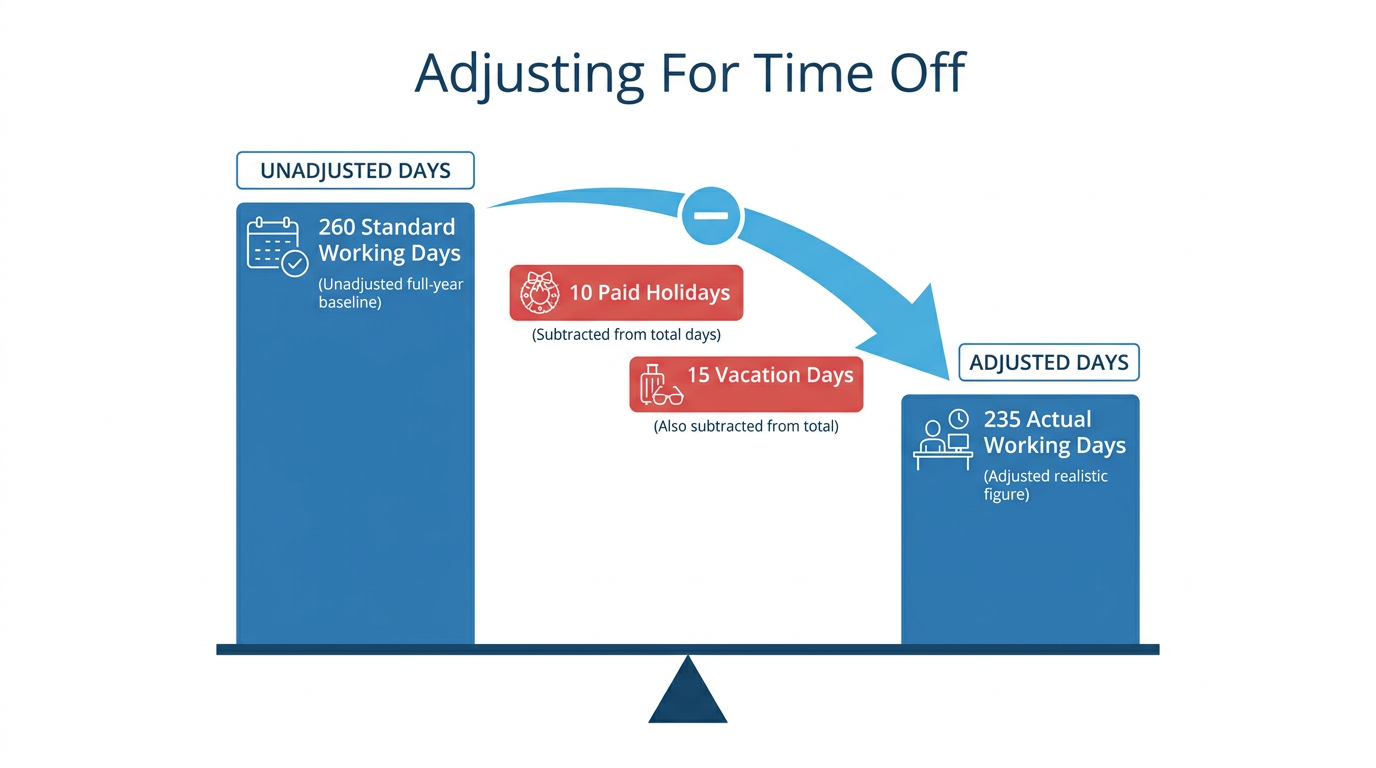
Adjusting annual salary for holidays and vacation days means subtracting your paid non-working days from the standard 260 working days before multiplying by your daily or hourly rate. The unadjusted figure assumes you clock in every scheduled day of the year, which almost nobody actually does once holidays, sick days, and vacation are factored in. The adjusted version gives you a more honest picture because it recognizes that you’re paid the same total salary while working fewer real hours. This distinction matters more than most people realize, since paid time off does not actually shrink your paycheck. It raises your effective hourly rate instead, because you’re earning the same annual total for less time on the clock. Someone earning $50,000 a year with 20 paid days off still takes home the full $50,000, but they’re doing it in fewer working hours than a colleague with no vacation at all, which makes their real hourly value higher even though the salary line on paper looks identical.
Worked example: subtracting non-working days
A quick example makes this concrete using a $30 hourly rate, 8 hours a day, and the standard 260 working days a year.
Unadjusted salary: $30 x 8 x 260 = $62,400
Non-working days: 10 holidays + 15 vacation days = 25 days
Actual working days: 260 – 25 = 235
Adjusted salary: $30 x 8 x 235 = $56,400
The same worker earns less in raw dollars on paper, but they’re working fewer days to get there, which is exactly the tradeoff worth understanding before comparing two offers with different time-off policies.
How do you convert between pay periods?
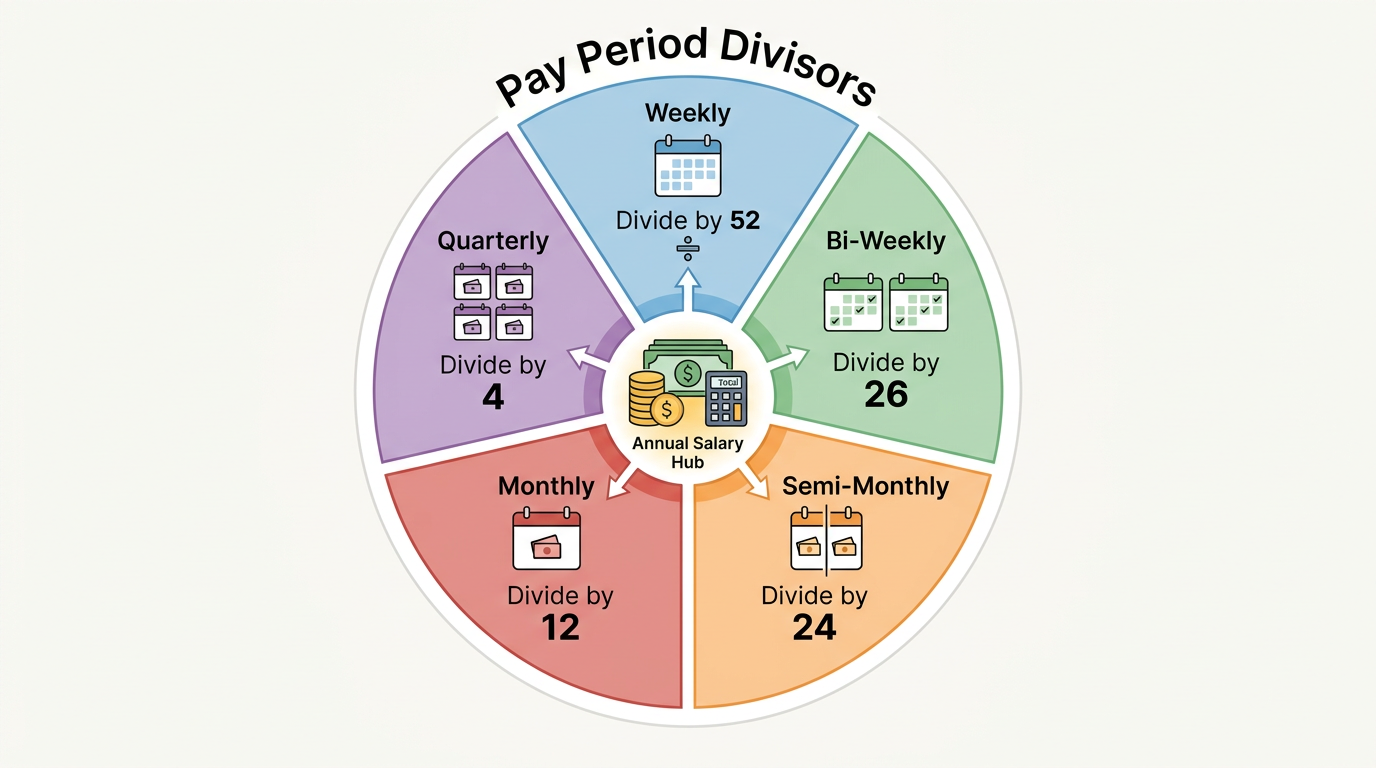
Converting between pay periods means dividing your annual salary by the number of paychecks you receive in a year, and each frequency has its own standard divisor. A weekly paycheck divides the annual total by 52, bi-weekly divides by 26, semi-monthly divides by 24, and monthly divides by 12. These numbers look similar but they are not interchangeable, and mixing them up is one of the most common mistakes people make when budgeting around a new job.
| Pay period | Divide annual salary by | Pay periods per year |
|---|---|---|
| Weekly | 52 | 52 |
| Bi-weekly | 26 | 26 |
| Semi-monthly | 24 | 24 |
| Monthly | 12 | 12 |
| Quarterly | 4 | 4 |
Bi-weekly and semi-monthly get confused constantly because both sound like “twice a month.” Bi-weekly means every two weeks, which produces 26 paychecks a year and occasionally two paychecks in the same month. Semi-monthly means twice a month, usually on the 15th and the last day, producing 24 paychecks with dates that shift depending on how many days that month contains.
How do you compare job offers with different pay structures?
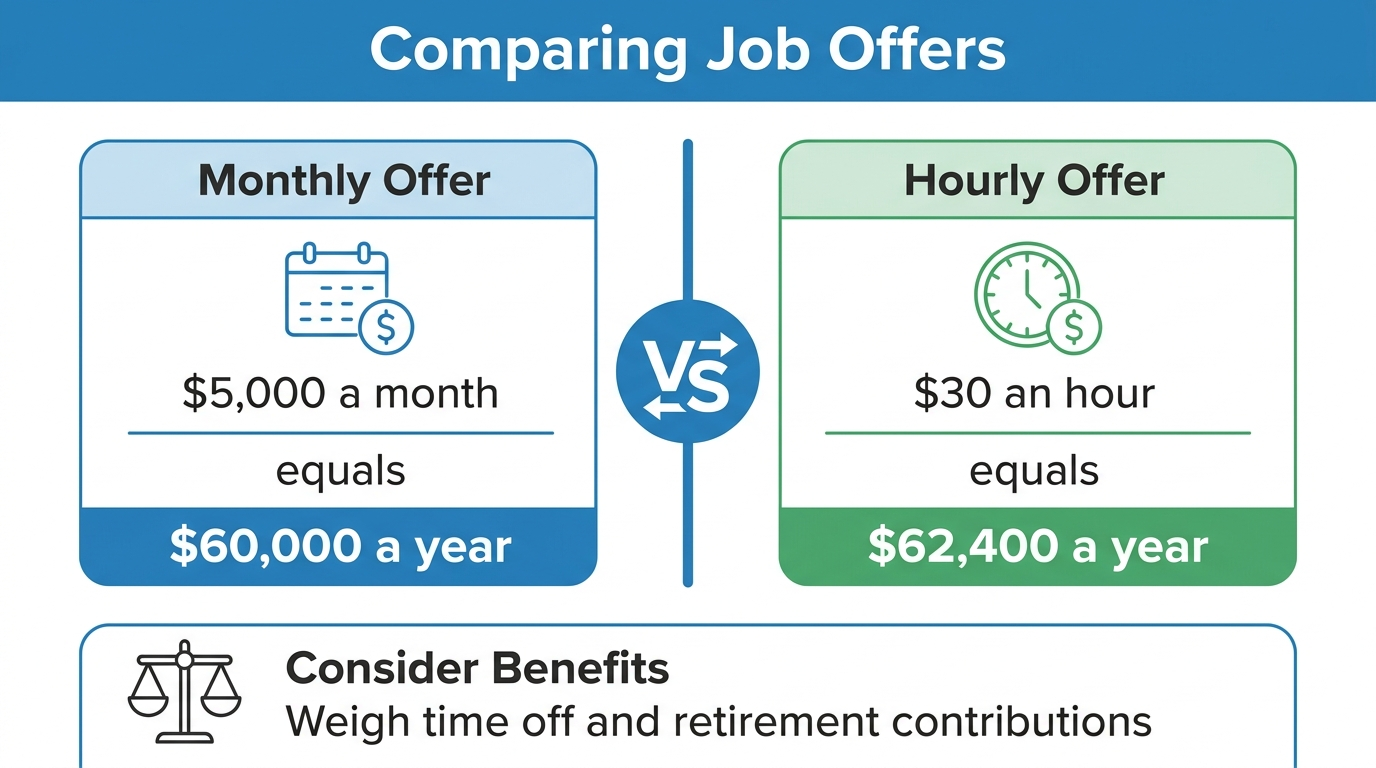
Comparing job offers with different pay structures requires converting every offer into the same annual figure, since a monthly number and an hourly number aren’t naturally comparable side by side. Take a job paying $5,000 a month against one paying $30 an hour for a standard 40-hour week. The monthly offer works out to $5,000 times 12, or $60,000 a year. The hourly offer comes to $30 times 40 times 52, or $62,400 a year, which is $2,400 more despite looking smaller on paper at first glance.
That gap shows exactly why converting everything to an annual figure before making a decision matters so much. Beyond the base number, it’s worth weighing paid time off, health benefits, and retirement contributions too, since a slightly lower salary with stronger benefits can outperform a higher number with a thin benefits package.
How do you estimate take-home pay from your annual salary?
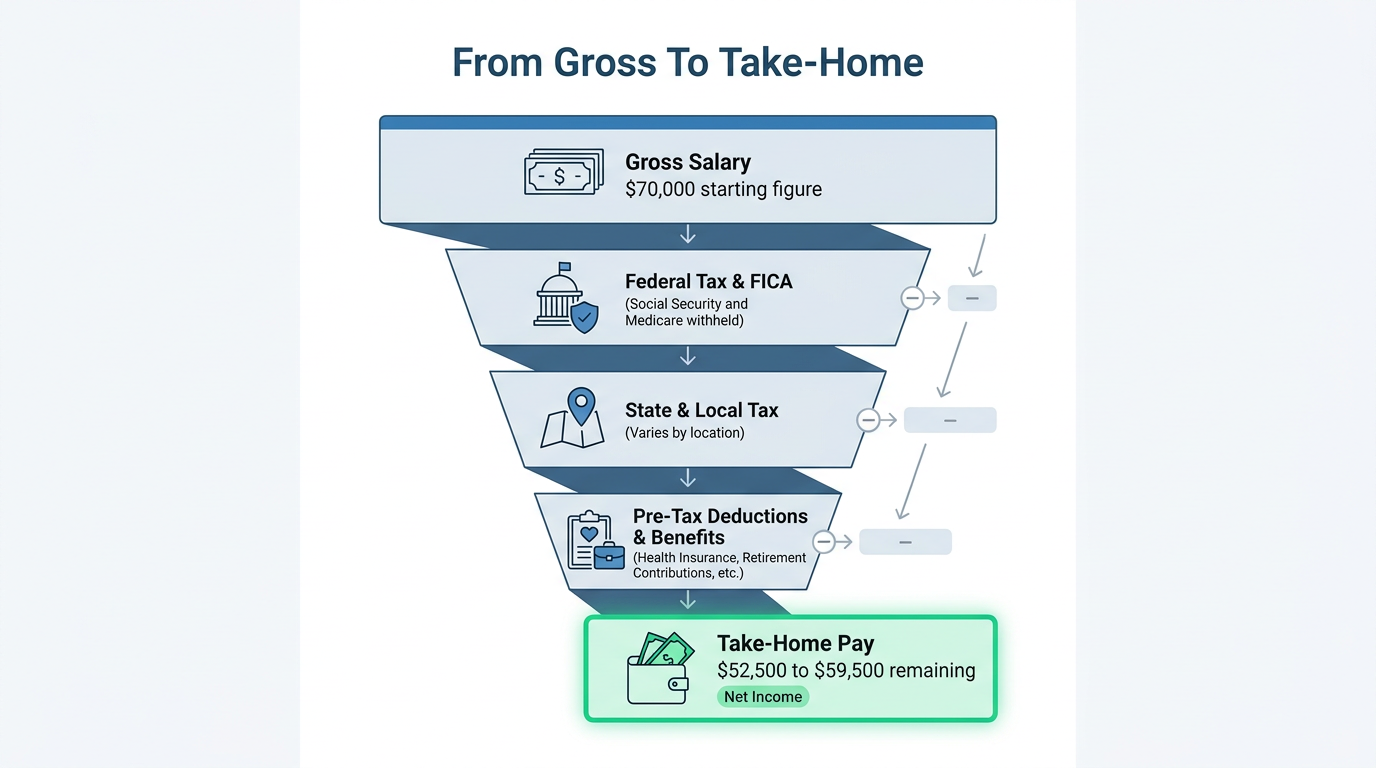
Estimating take-home pay from your annual salary means subtracting federal tax, FICA, state and local tax, and any benefit contributions from your gross figure to see what actually lands in your account. FICA covers Social Security and Medicare, with employees paying 6.2% and 1.45% respectively, matched by the employer. Add in federal withholding based on your Form W-4, plus state and local taxes that vary by location, and you get a full deduction picture that no single number can capture perfectly, which is why most people rely on a rough percentage instead.
A common rule of thumb puts total deductions somewhere between 15% and 25% of gross income, depending on your state and personal situation, which lines up with recent reporting on what percentage of taxes gets taken out of paychecks nationally.
On a $70,000 gross salary, a 25% deduction rate leaves $52,500 in take-home pay, while a 15% rate leaves $59,500. That $7,000 spread shows just how much your specific tax situation can shift the final number, so treat these figures as a starting estimate rather than an exact paycheck prediction.
Calculate your exact salary instantly with a free tool
Running these formulas by hand works fine for a quick estimate, but a browser-based calculator handles every pay period conversion instantly without any manual multiplication or risk of a math slip. Tools Repository offers exactly this kind of tool, letting you enter an hourly, weekly, or monthly figure and see the full breakdown across every other pay frequency in seconds. Because everything runs locally in your browser, none of your income details ever get sent to a server or stored anywhere, which matters if you’d rather keep your pay details private while comparing offers or checking your own numbers.
There’s no sign-up wall, no subscription, and no software to install before you can use it. That kind of straightforward access fits naturally into the workflow of freelancers checking their effective hourly rate, students budgeting a first job offer, or small business owners estimating payroll costs without opening a spreadsheet.
The takeaway
Working out an accurate yearly figure starts with one simple equation, pay rate multiplied by pay periods, but the honest number depends on a few more steps. Adjusting for holidays and vacation days shows your real effective rate, converting between pay periods clears up paycheck confusion, and estimating deductions gets you closer to what actually lands in your account. Each of these calculations builds on the last, so once you’re comfortable with the basic formula, the rest follows naturally.
If you’d rather skip the manual arithmetic altogether, a free calculator from the platform can run every one of these conversions in seconds, right in your browser, without asking for a login or storing your data anywhere. Whether you’re negotiating a raise, comparing two offers, or just curious what your hourly grind adds up to over a year, the numbers are worth knowing precisely.
Frequently asked questions
Question: How many work hours are in a year?
A standard full-time work year totals 2,080 hours, based on 40 hours a week across 52 weeks. This figure is known as the Full-Time Equivalent, or FTE, and it’s the baseline most payroll systems and salary calculators use before adjusting for overtime, part-time schedules, or unpaid time off.
Question: What’s the difference between salary and wage?
Salary is a fixed annual amount paid regardless of hours worked in a given week, while a wage is calculated by multiplying an hourly rate by actual hours worked. Wage earners are usually classified as non-exempt under the Fair Labor Standards Act, meaning they qualify for overtime pay, while salaried workers are often exempt.
Question: How do I calculate my annual salary if I get paid bi-weekly?
Multiply your bi-weekly paycheck amount by 26, since bi-weekly pay produces 26 pay periods in most years. For example, a $2,000 bi-weekly paycheck comes to $52,000 a year. This is different from semi-monthly pay, which only has 24 pay periods annually.
Question: Does paid time off reduce my annual salary?
No, paid time off does not reduce your annual salary at all. You still receive your full agreed salary while working fewer actual hours, which effectively raises your true hourly value even though the yearly dollar figure on your contract stays the same.
Question: What’s considered a good annual salary in the US?
Recent Bureau of Labor Statistics wage data puts average full-time earnings at roughly $63,128 a year, which offers a rough national benchmark. What counts as “good” really depends on your industry, location, and local cost of living, so compare against similar roles in your specific area.
Question: How much of my salary goes to taxes?
Total deductions, including federal income tax, FICA, and state tax, typically range from about 15% to 25% of gross income. The exact percentage depends on your state, filing status, and any pre-tax benefit contributions, so treat this range as a general planning estimate rather than an exact figure.