
How to Calculate Mortgage Payments Step by Step

Alisha Anjum

When you first search how to calculate mortgage payments, the formula can look like something only lenders understand. The good news is that the monthly payment comes from one standard equation that you can run yourself. You set M = P × [r(1 + r)^n / ((1 + r)^n − 1)], where P is your loan amount, r is your monthly interest rate, and n is your number of payments. With those 3 inputs, you can find the principal and interest part of your payment by hand.
The hard part is less about the math and more about knowing what numbers to plug in. In this guide, we will unpack the formula in plain language, show a worked example, explain what really goes into a full payment, and point to free tools that do the heavy lifting for you. Platforms like Tools Repository collect these calculators in one private, no-signup place so you can test ideas safely. Keep reading to see the steps once, then let tools handle the repetitive work.
Key takeaways
You can calculate mortgage payments with one standard formula. It uses your loan amount, interest rate, and term. Once you learn it, the math feels routine.
Real mortgage bills include more than principal and interest. Taxes, homeowners insurance, and mortgage insurance often sit inside the same payment. Knowing that gap helps you avoid sticker shock later.
Your down payment, loan term, and interest rate change payment size the most. Small shifts in any of these can change affordability a lot.
Free online calculators run the same formula that lenders use. They give instant answers without spreadsheets, and good ones keep your data inside your browser.
“Do the math before you fall in love with a house, not after.”
— Liz Weston, personal finance columnist
Table of Contents
- How do you calculate a mortgage payment by hand?
- What actually makes up your monthly mortgage payment?
- Which inputs change your mortgage payment the most?
- How can you skip the manual math?
- The takeaway
- Frequently asked questions
How do you calculate a mortgage payment by hand?
To calculate a monthly mortgage payment by hand, you use the standard amortization formula with your loan details. That formula spreads your loan balance and interest across equal monthly payments so the amount you pay each month stays the same. Once you know the structure, you can work it out with a basic calculator or even in a notebook.
The mortgage payment formula explained
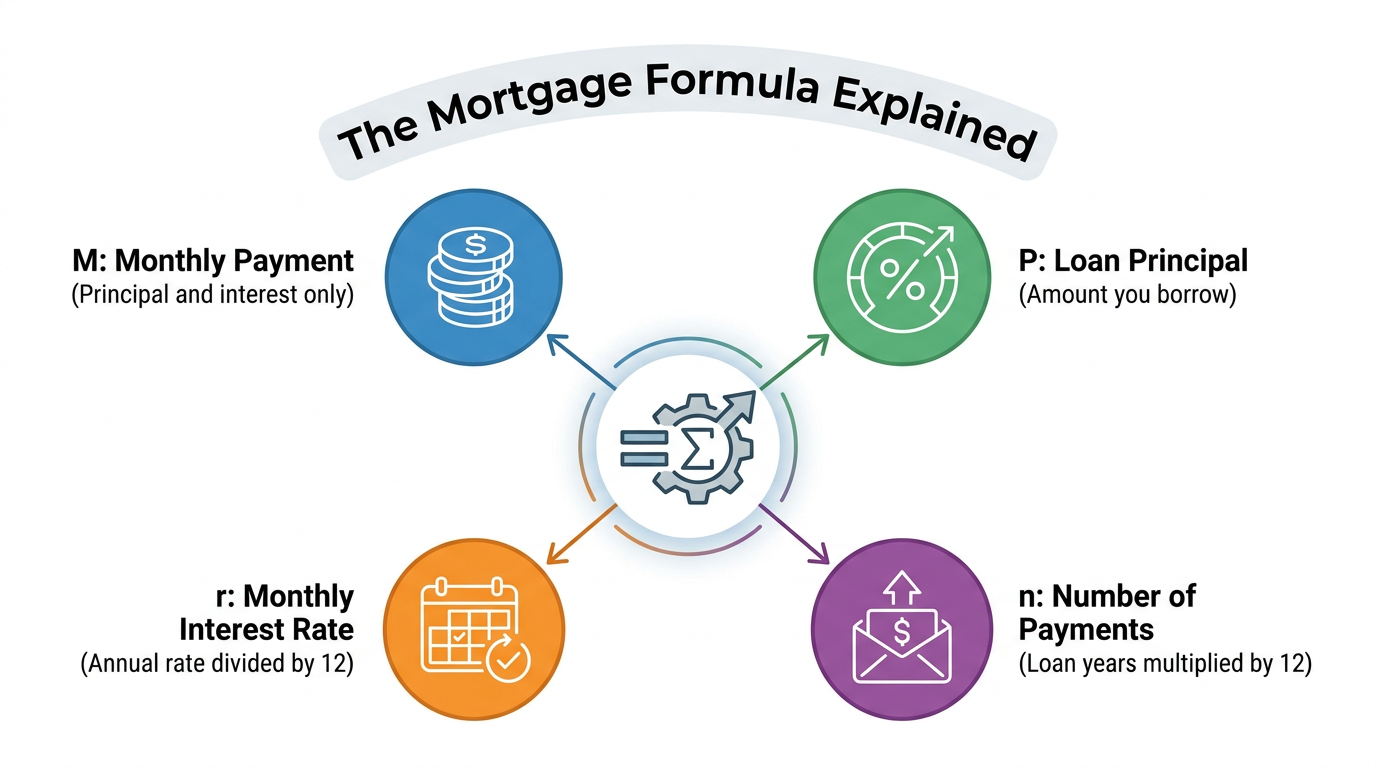
The core mortgage payment formula is:
M = P × [r(1 + r)^n / ((1 + r)^n − 1)]
Here:
M is your monthly payment for principal and interest
P is the loan principal
r is the monthly interest rate
n is the total number of monthly payments
It looks dense at first, but each piece comes straight from your loan quote.
To convert your annual rate into a monthly rate, you divide by 12, a step rooted in standard interest rate market pricing and compounding conventions that lenders rely on to structure amortizing loans. If your rate is 6 percent, r = 0.06 ÷ 12, which equals 0.005. To find n, you take the years in your term and multiply by 12. A 30‑year mortgage has 360 payments, while a 15‑year mortgage has 180 payments.
Inside the brackets, you:
Raise (1 + r) to the power of n
Multiply that result by r
Divide by the same power minus 1
That fraction is the payment factor. When you multiply the factor by your principal P, you get the monthly payment that will pay the loan down to zero on the last scheduled month.
Tip: Write the formula on a notecard or save it in your phone. Once you use it a few times, it starts to feel familiar rather than scary.
A quick worked example
Say you borrow 300,000 dollars at 6 percent interest for 30 years. Here P = 300000, the annual rate is 0.06, r = 0.06 ÷ 12 = 0.005, and n = 30 × 12 = 360. Those 3 numbers completely describe the loan.
Step by step:
Calculate (1 + r)^n, which is (1.005)^360
On a scientific calculator, you get roughly 6.0226
Multiply that by r
0.005 × 6.0226 ≈ 0.0301
Subtract 1 from 6.0226 to get the denominator
6.0226 − 1 = 5.0226
Divide 0.0301 by 5.0226
0.0301 ÷ 5.0226 ≈ 0.00599
That 0.00599 is your payment factor. Now multiply by the principal:
0.00599 × 300000 ≈ 1797 per month
That is the principal and interest part of the payment only, not taxes or insurance. Tools like the Loan EMI Calculator on Tools Repository run this same math in milliseconds and show a full payment breakdown so you do not have to repeat these steps by hand every time.
What actually makes up your monthly mortgage payment?
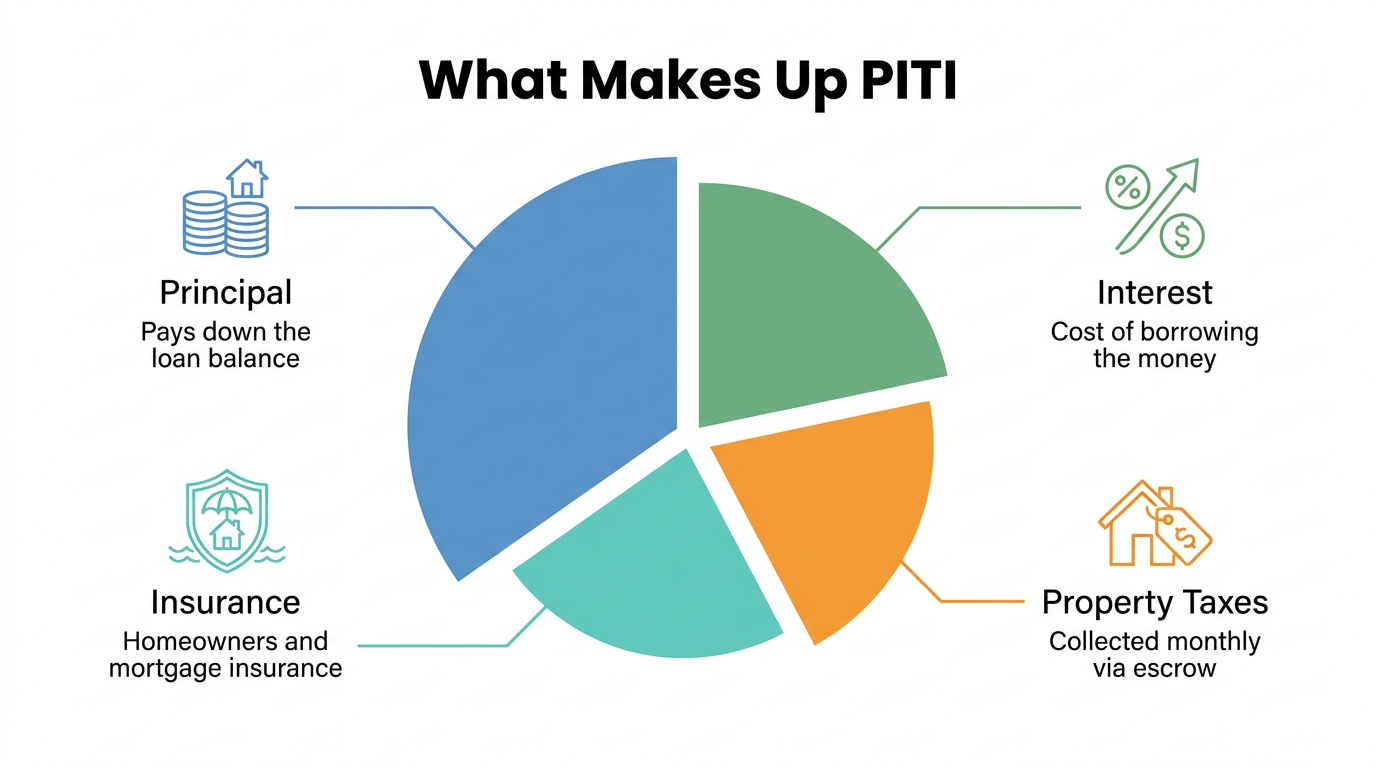
Your monthly mortgage payment usually includes more pieces than the pure formula suggests. Lenders like to bundle several housing costs into one payment because it lowers the chance that taxes or insurance fall behind. The common label for this bundle is PITI, which stands for principal, interest, taxes, and insurance.
Think of your payment as four main parts:
Principal
Interest
Property taxes
Insurance (homeowners and, when needed, mortgage insurance)
Principal and interest
Principal is the amount you borrow to buy the home, after subtracting your down payment. If the purchase price is 400,000 dollars and you put down 80,000, your starting principal is 320,000. Interest is the price you pay the lender for using that money.
On a standard fixed‑rate loan:
Your total payment stays the same each month
The mix of principal and interest inside that payment changes over time
At the start, most of each payment goes toward interest and only a small slice cuts the balance. Over time, more of each payment goes toward principal and your equity grows faster.
“With an amortizing loan, time is on your side. The more months you survive, the more principal you pay.”
— J.L. Collins, The Simple Path to Wealth (paraphrased)
Mortgage insurance (PMI)
Private mortgage insurance, or PMI, applies when your down payment is under 20 percent on most conventional loans, a threshold tied to loan-to-value ratios that researchers studying urbanization and excess mortgage risk have shown to meaningfully affect default exposure in housing markets. In that case your loan‑to‑value ratio is above 80 percent, and the lender wants extra protection in case you stop paying. PMI protects the lender, not you, but you still pay for it.
Typical PMI costs run from about 0.46 percent to 1.50 percent of the loan amount per year, depending on credit score and loan type. To estimate a monthly PMI charge:
Pick a rate inside that range
Multiply it by your loan amount
Divide by 12
For example, on a 250,000 loan at a 0.8 percent PMI rate, you pay about 2,000 per year, or roughly 167 per month.
Government‑backed programs treat mortgage insurance differently:
FHA loans use their own upfront and annual premiums, often for the full term, depending on down payment
VA loans for service members skip PMI but use a funding fee instead
Many USDA loans for rural buyers follow a similar pattern with their own fee structure
Taxes, insurance, and escrow
Property taxes are local charges based on your home’s assessed value, and they fund schools, roads, and other public services. A common rough estimate is 1 percent to 1.25 percent of the home value per year, though some areas are lower and some are much higher. To fit that into a monthly budget, you take the yearly estimate and divide by 12.
Homeowners insurance protects the structure and your belongings from fire, theft, and other named losses. Many policies cost less than 1 percent of the home price each year, but the exact premium depends on coverage level, location, and claim history. Your lender almost always wants the insurance payment collected monthly and held in an escrow account.
If you live in a condo or planned community, you may also pay homeowners association dues. HOA fees are not part of the official debt‑to‑income ratio that underwriters at Fannie Mae or Freddie Mac calculate, but they still affect how much home truly fits your budget. When your lender manages escrow, it adds estimated taxes, insurance, and sometimes HOA costs to the principal and interest payment so everything gets paid on time.
Tip: When you compare homes, compare the total monthly cost, not just principal and interest. Taxes, insurance, and HOA fees can make two similar‑priced houses feel very different.
Which inputs change your mortgage payment the most?
The inputs that change your mortgage payment the most are your down payment, loan term, and interest rate. You have some control over all three by saving more, choosing a different term, or improving your credit and shopping among lenders. Understanding how each knob works lets you shape a payment that matches your comfort level.
Down payment and loan term
Your down payment directly decides how much you borrow and whether PMI applies. Many conventional loans allow as little as 3 percent down, FHA loans often start at 3.5 percent, and some VA or USDA loans can go as low as zero down for eligible borrowers. A 20 percent down payment is not required, but it usually removes PMI and leads to lower monthly costs.
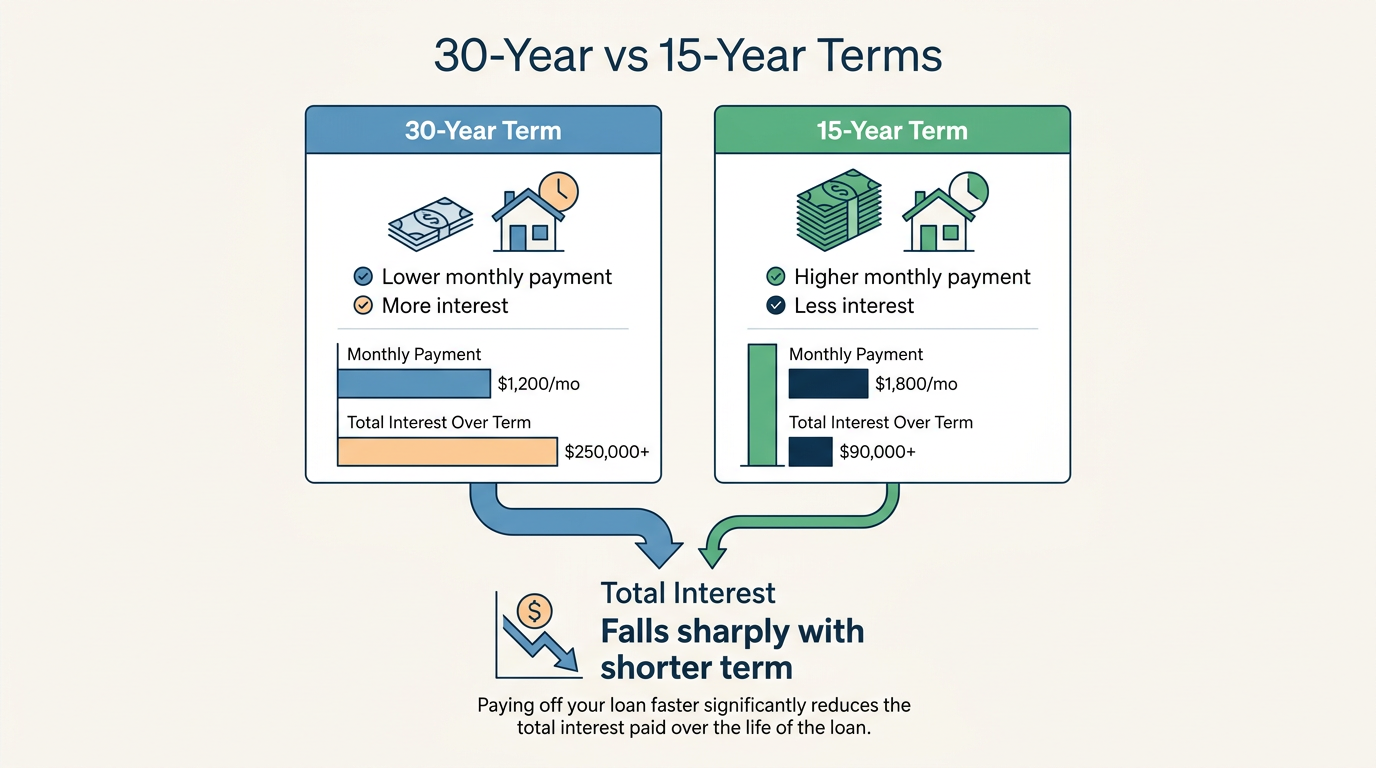
Loan term controls how long you spread those payments:
A 30‑year term gives you the smallest monthly payment for a given rate and principal, which is why it is the most common choice in the United States
A 15‑year term trims the total interest a lot but raises the monthly bill because you clear the balance in half the time
Imagine that same 300,000 loan at 6 percent interest:
Over 30 years the principal and interest payment is around 1,800 per month
Over 15 years the monthly payment jumps well above 2,500
The total interest across the life of the loan falls by many tens of thousands with the shorter term
The right choice depends on your income, savings plans, and how steady your cash flow feels. Some borrowers split the difference by taking a 30‑year loan but paying a bit extra each month as if it were a 20‑ or 25‑year term.
Interest rate and credit score
Your interest rate sets the slope of the entire payment stream, so every fraction of a percent matters. A move from 6.0 percent to 6.5 percent can add more than 100 dollars per month on a typical 300,000 loan. Over decades, that extra payment adds up to tens of thousands of extra interest dollars.
Lenders base the rate they offer on your credit profile, your down payment, the loan type, and your property’s ZIP code. Strong credit scores can lead to better pricing through conventional lenders or programs backed by FHA, VA, or USDA. Comparing quotes from several lenders or marketplaces like Bankrate or NerdWallet can expose rate differences that matter much more than a slightly higher home price.
Simple ways to aim for a better rate include:
Paying all bills on time for many months before applying
Reducing credit card balances to lower your credit utilization
Avoiding new credit accounts right before your mortgage application
Sample payments by home price
To put some numbers to these ideas, here is an example table. It shows estimated monthly payments for a 30‑year fixed loan at 7 percent interest with 15 percent down, including rough estimates of PMI, property taxes, and homeowners insurance.
| House price | Mortgage amount | Estimated monthly payment |
|---|---|---|
| 100,000 | 85,000 | 566 |
| 200,000 | 170,000 | 1,016 |
| 300,000 | 255,000 | 1,603 |
| 400,000 | 340,000 | 2,138 |
| 500,000 | 425,000 | 2,702 |
| 600,000 | 510,000 | 3,619 |
| 700,000 | 595,000 | 4,222 |
| 800,000 | 680,000 | 4,825 |
Your own payment will differ based on local taxes, exact rate, and insurance quotes, but the pattern is clear. As home price and loan size rise, the payment scales quickly, which is why down payment size and rate shopping matter so much.
“When you’re stretching for a house, don’t just ask ‘Can I qualify?’ Ask ‘Will this still feel comfortable if life throws me a curveball?’”
— Ramit Sethi, personal finance author (paraphrased)
How can you skip the manual math?
You skip the manual mortgage math by using calculators that run the same formula for you. Once you understand what the variables mean, a good calculator saves time, reduces slipups, and makes it easy to compare many what‑if cases. That frees you to focus on planning instead of punching numbers.
Tools that do the math for you
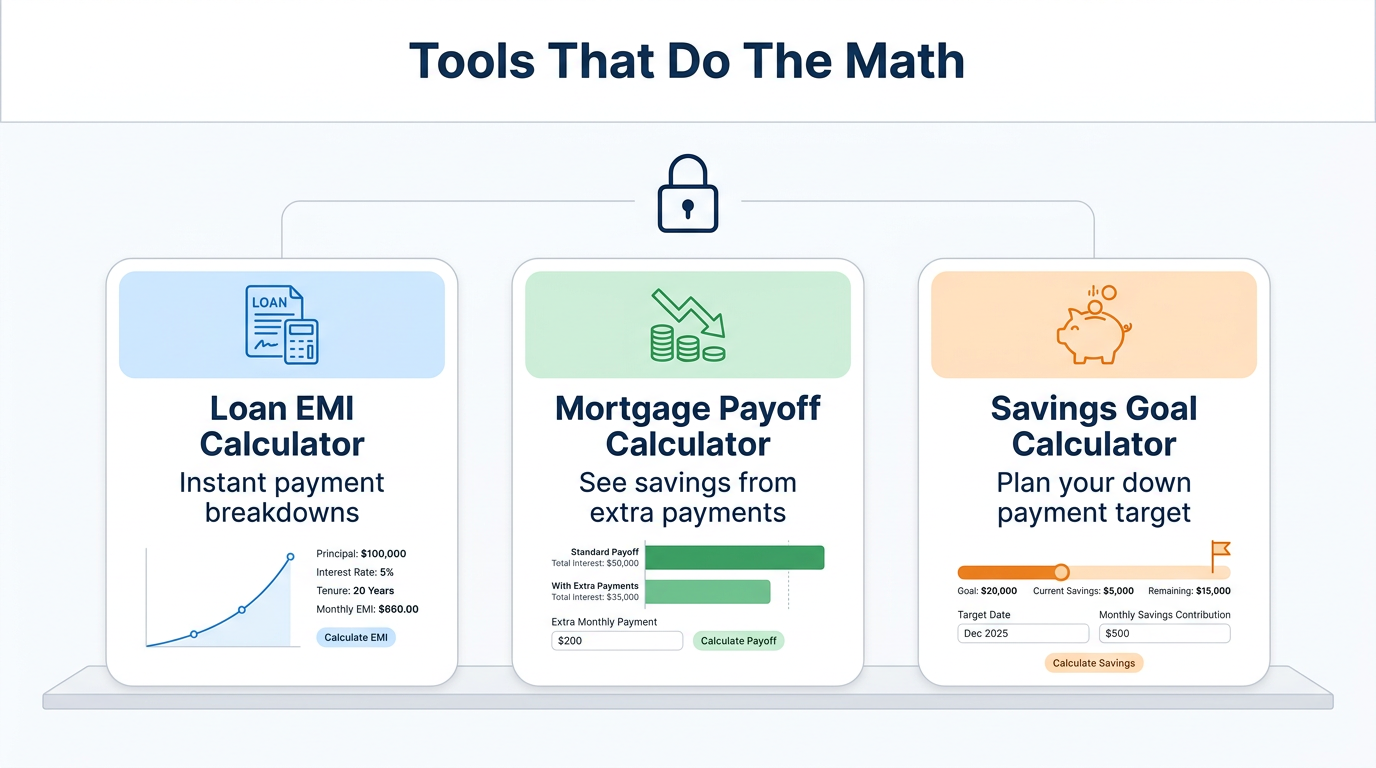
Online mortgage calculators use the amortization formula under the hood, just like banks. You type in the loan amount, interest rate, and term, and they return the monthly principal and interest, plus totals over the full term. Many also accept estimates for property taxes, homeowners insurance, PMI, and HOA dues so you see a realistic monthly number.
Tools Repository groups several helpful calculators in one clean place. Its Loan EMI Calculator gives instant payment breakdowns for mortgages and other installment loans. The Mortgage Payoff Calculator shows how extra payments each month or each year can shorten your term and cut interest. A Savings Goal Calculator helps you plan a down payment target and see how long different savings rates will take.
These tools run inside your browser, so your loan amounts and income figures are not sent to a remote server. There is no login wall, no subscription, and no personal data requirement, which works well for privacy‑minded developers, students, and freelancers. Once you trust that the formulas match what lenders use, you can rely on calculators to handle most future questions with a few quick changes to the inputs.
Tip: Save a few sample scenarios inside a spreadsheet or notebook. Then when rates move or your budget changes, you can quickly update just one or two numbers and compare.
A note on debt-to-income ratio
Your debt‑to‑income ratio, or DTI, answers how much house payment you can afford on paper. You calculate it by taking your total monthly debt payments and dividing by your gross monthly income before taxes. The result, written as a percent, is a key number lenders use when they review applications.
A common rule of thumb, often called the 28/36 rule, says housing costs should stay near 28 percent of your gross income, and all debt, including the mortgage, should stay near 36 percent. For example, if you earn 5,000 per month before tax, many lenders want your full mortgage payment at or below about 1,400.
A quick way to track DTI:
Add up monthly payments on credit cards, auto loans, student loans, and personal loans
Add your estimated full mortgage payment (principal, interest, taxes, insurance, and any PMI)
Divide that total by your gross monthly income
Checking DTI before you lock onto a target price can save you from falling for a payment that feels tight once you add real‑life expenses.
The takeaway
The takeaway from learning mortgage math is that monthly payments are not magic; they are predictable. Once you know the basic formula for principal and interest and you add taxes, insurance, and any mortgage insurance on top, you can estimate your true payment with confidence. That makes shopping for homes and comparing loans far less stressful.
You do not have to run the full amortization formula by hand every time you tweak a number. Instead, think of the formula as your mental model and use calculators to handle the heavy computation. Privacy‑friendly tools such as those on Tools Repository give you quick answers without signups or tracking, and a lender can later confirm the figures before you make any binding decision.
“The more you understand your numbers, the less scary big financial choices feel.”
— Anonymous homebuyer
Frequently asked questions
Question: How do you figure a mortgage payment without a calculator?
Answer: You figure a mortgage payment by using the standard amortization formula M = P × [r(1 + r)^n / ((1 + r)^n − 1)]. Convert the annual rate to a monthly rate, count your total number of payments, then follow the order of operations step by step. It takes patience, which is why most people rely on calculators once they understand the structure.
Question: How much interest will I pay on my mortgage over time?
Answer: The total interest you pay depends on your loan amount, interest rate, term length, and any extra payments you make. You can estimate it by multiplying your monthly payment by the number of payments, then subtracting the original principal. An amortization schedule or payoff calculator shows this more clearly and lets you see how extra payments shrink the total interest.
Question: What is a mortgage amortization schedule?
Answer: A mortgage amortization schedule is a table that shows every payment from your first month to your last. Each row lists how much of that payment goes to interest, how much goes to principal, and what balance remains. Early rows are interest‑heavy, while later rows shift toward principal as you pay the loan down.
Question: How to calculate home loan payments with taxes and insurance included?
Answer: You start with the principal and interest payment from the amortization formula. Then you add monthly estimates for property taxes, homeowners insurance, and any PMI or HOA dues. For taxes and insurance, take the yearly amounts and divide by 12. Many Auto Loan Calculator let you enter these extra items directly so the full payment appears in one number.
Question: How much down payment do I need for a house?
Answer: Many conventional loans accept down payments as low as 3 percent, while FHA loans often start around 3.5 percent. VA and USDA programs can allow zero percent down for eligible buyers. A 20 percent down payment is helpful because it usually removes PMI and lowers monthly cost, but it is not a hard requirement.
Question: Can extra payments really shorten my mortgage?
Answer: Yes, extra payments usually go straight toward principal, which reduces future interest charges, an effect examined in research on mortgage curtailment income and substitution effects that looked at how borrowers change extra-payment behavior over time. Even adding a modest amount each month or making one extra payment per year can cut years off a 30‑year schedule. A Mortgage Payoff Calculator shows exactly how much time and interest you save when you increase your payment in different ways.