
How to Calculate Simple Interest: Formula & Examples

Alisha Anjum
How do you calculate simple interest step by step? You multiply the principal amount by the interest rate (as a decimal) and by the time period in years, using the formula I = P × r × t. This one formula answers most simple interest questions you’ll ever face, whether you’re checking a loan, a savings account, or a homework problem.
Figuring out how to calculate simple interest trips up a lot of people, mostly because of two small steps that get skipped. You need to convert your percentage rate into a decimal, and you need to convert your time period into years if it’s given in months or days. Skip either step and your answer will be wrong, even if your math is otherwise perfect.
This guide walks through the formula, shows several worked examples using real numbers, and covers how to solve for principal, rate, or time when those are the unknowns instead. We’ll also compare simple interest against compound interest, since knowing the difference actually changes which loans or savings accounts make sense for you. Along the way, we’ll point you toward some free calculators from Tools Repository that let you double-check your work without typing your numbers into some random site.
Let’s start with the basics before moving into the step-by-step math.
Key takeaways
The simple interest formula is I = P × r × t, where P is your principal, r is the annual rate as a decimal, and t is time in years.
To find the total amount owed or earned, use A = P(1 + rt), which combines principal and interest into one number.
Convert months into years by dividing by 12, and convert days into years by dividing by 365, before plugging them into t.
You can rearrange the formula to solve for principal, rate, or time, as long as you already know the other three values.
Simple interest tends to help borrowers by keeping costs predictable, while compound interest tends to help savers by growing money faster over time.
Table of Contents
- What is simple interest and how does it work?
- How to calculate simple interest step by step
- How to solve for principal, rate, or time
- Simple interest vs. compound interest: which matters more?
- Verify your math with free calculators
- Frequently asked questions
- Question: How do you calculate simple interest on a loan?
- Question: What is the difference between I = Prt and I = Prn?
- Question: Can simple interest change over the life of a loan?
- Question: What types of loans or accounts use simple interest?
- Question: How do I calculate simple interest for a partial year, like 3 months?
- Question: Is a 360-day or 365-day year used for simple interest?
- The takeaway
What is simple interest and how does it work?
Simple interest is a way of calculating interest that only applies to the original principal, the initial amount you borrowed, deposited, or invested. It never factors in any interest that’s already been earned or charged, which makes it a much more predictable calculation than the compounding method used by most credit cards and savings accounts. You’ll run into simple interest anytime you’re paying interest on a loan or earning interest on a deposit, since it applies in both directions.
Because the base amount never shifts, simple interest grows at the same steady rate for the entire term. If you’re borrowing money, this usually works out in your favor, since you’re not paying interest on top of interest. If you’re saving or investing, it’s the opposite story, since your money grows more slowly than it would under compounding.
Key characteristics of simple interest
Simple interest carries a few defining traits that make it easier to plan around and easier to spot on paper. These traits show up whether you’re comparing loan offers or checking a CD’s terms before opening one.
Linearity means interest builds at a constant, unchanging rate the entire time, so a graph of the growth would be a straight line rather than a curve. This makes forecasting simple, since doubling the time period just doubles the interest.
Predictability comes from the fact that the rate and principal never change, so you can calculate the exact interest owed or earned at any point in the future. That’s useful for budgeting a loan payoff or planning around a fixed-term investment.
It applies in two directions, meaning it can show up as a charge on money you’ve borrowed or as earnings on money you’ve deposited, such as in a basic savings account, CD, or bond.
How to calculate simple interest step by step
Calculating simple interest step by step means multiplying your principal, your annual rate, and your time period together using I = P × r × t. Once you know what each letter stands for, the math itself takes just a few seconds on any calculator.
The trick is getting your inputs into the right format before you multiply. Interest rates are usually written as percentages, and loan or deposit terms aren’t always given in a neat number of years, so a little prep work upfront saves you from a wrong answer later.
The simple interest formula explained
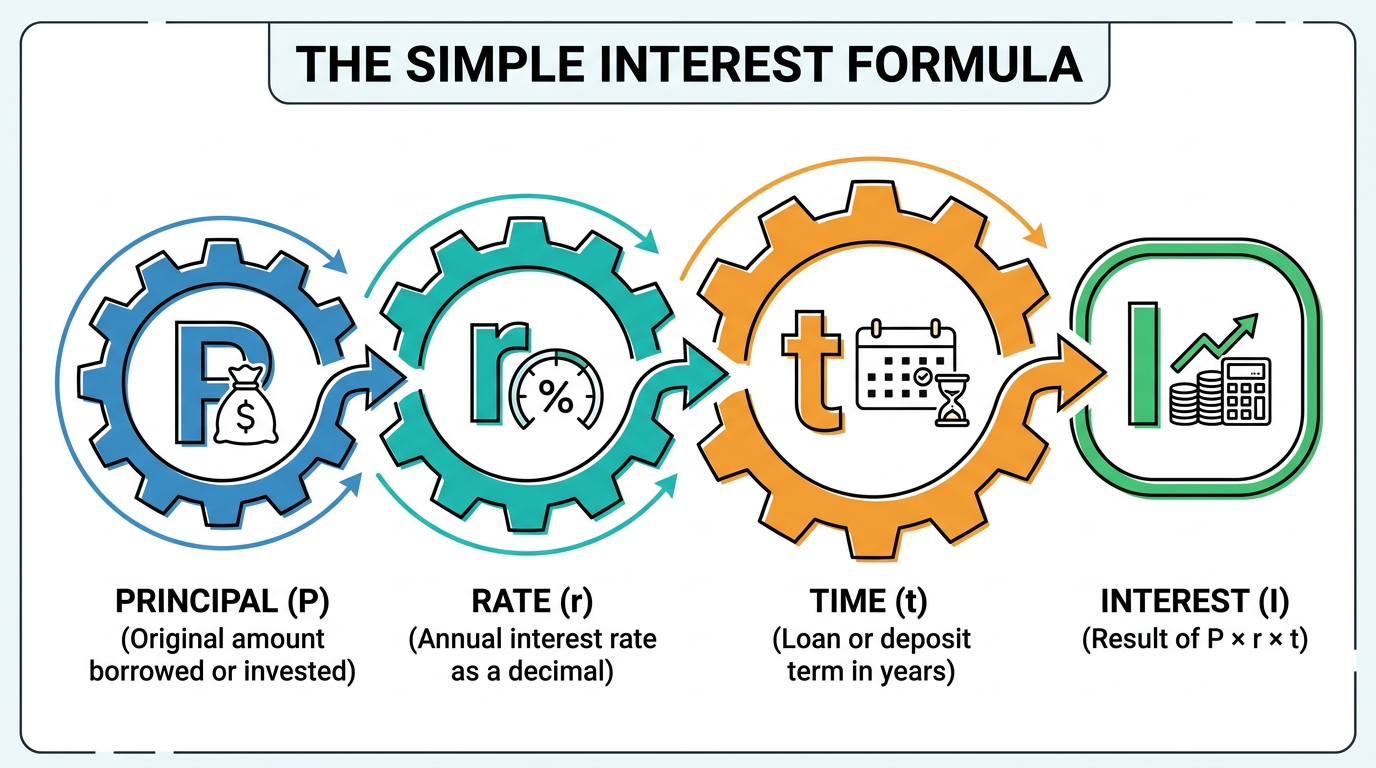
The formula breaks down into three parts, each representing a piece of your financial situation. Understanding what each letter means makes the whole thing much less intimidating, whether you’re a student working through homework or a freelancer sizing up a loan offer.
P stands for principal, the original amount of money borrowed, deposited, or invested, before any interest gets added.
r stands for the annual interest rate, but it must be written as a decimal rather than a percentage. To convert, just divide the percentage by 100, so 5% becomes 0.05 and 3.875% becomes 0.03875.
t stands for time, expressed in years, which means you need to convert months or days into a fraction of a year before using them in the formula.
One rule matters more than any other here: r and t need to use matching time units. If your rate is annual, your time needs to be in years too, or your answer will be off by a wide margin.
Worked example: calculating interest on a loan
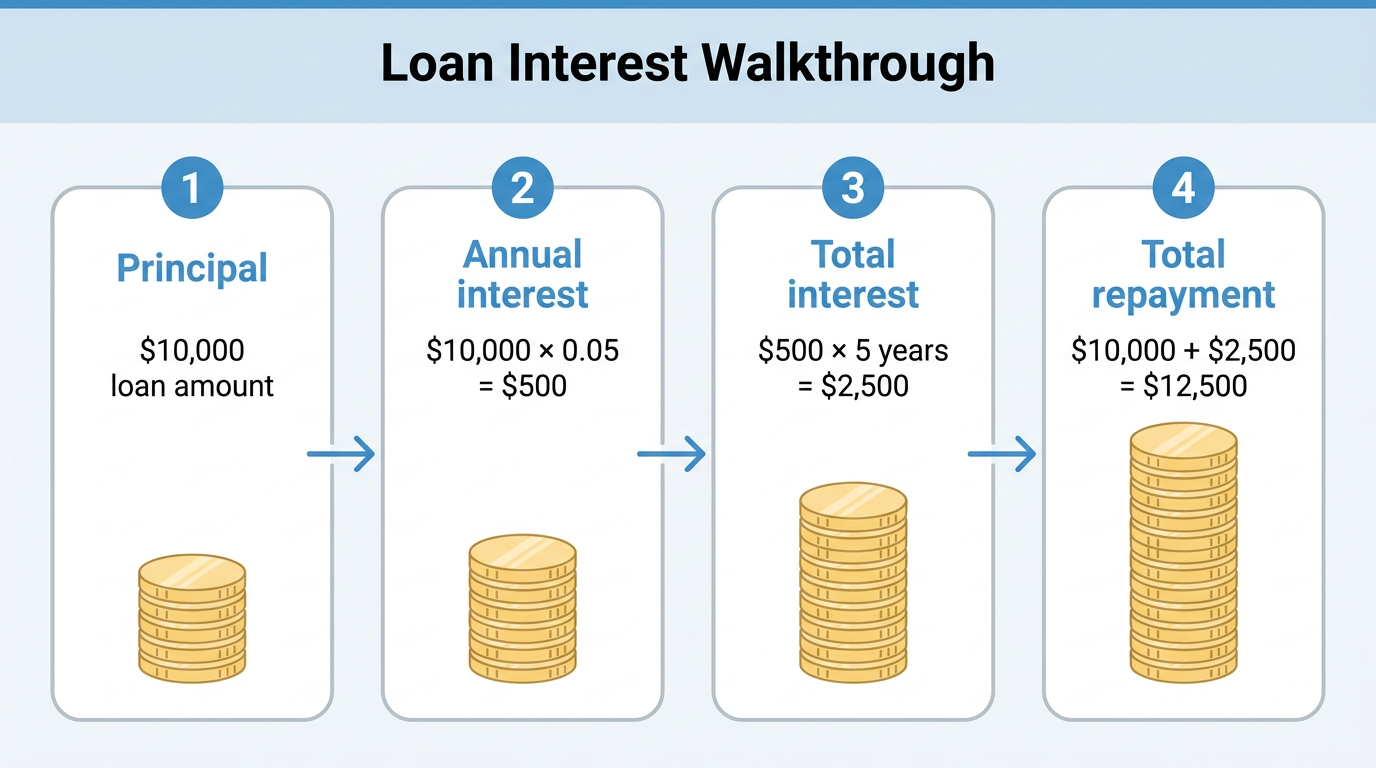
Picture a $10,000 loan at a 5% annual simple interest rate, repaid over 5 years. Working through this with real numbers makes the formula click a lot faster than staring at letters.
First, multiply the principal by the annual rate: $10,000 × 0.05 = $500. That $500 represents one year’s worth of interest. Next, multiply that number by the number of years in the loan term: $500 × 5 = $2,500. That’s your total interest owed across the entire loan.
To find your total repayment amount, just add that interest back to the principal: $10,000 + $2,500 = $12,500. If you wanted a monthly or daily interest figure instead, you could divide that $2,500 total by the number of months or days in the loan term.
Finding the total amount: A = P(1 + rt)
If what you actually want is the total balance, principal plus interest combined, there’s a faster route than calculating interest separately and adding it in afterward. The formula A = P(1 + rt) gets you there in a single pass, since it factors the principal out algebraically from A = P + Prt.
Say you invest $10,000 at 3.875% annual interest for 5 years. First, convert the rate to a decimal, giving you 0.03875. Plug that into the formula: A = 10,000 × (1 + (0.03875 × 5)), which simplifies to A = 10,000 × 1.19375, landing on a final total of $11,937.50.
To isolate just the interest earned, subtract the principal from that total: $11,937.50 − $10,000 = $1,937.50. That’s the exact same interest figure you’d get using I = Prt separately, just reached in fewer steps.
Calculating simple interest for months or days
Loan and deposit terms don’t always land on a clean number of years, so you’ll often need to convert a shorter period into its equivalent fraction of a year. For months, divide by 12. For days, divide by 365, which is the standard convention used in most simple interest calculations.
Say you open a 9-month CD for $10,000 at a 4% rate. Converting 9 months to years gives you 9 ÷ 12 = 0.75. Plugging that into A = P(1 + rt) gives A = 10,000 × (1 + (0.04 × 0.75)) = $10,300, meaning you’d earn $300 in interest.
Now try a 548-day investment of $10,200 at 3.5%. Converting days to years gives 548 ÷ 365 = 1.50137. That produces A = 10,200 × (1 + (0.035 × 1.50137)) = $10,735.99, or $535.99 in interest earned. Some banks use a 360-day year instead of 365 for certain commercial calculations, so it’s worth checking your specific agreement if the numbers ever look slightly off from what you expect.
How to solve for principal, rate, or time
Solving for principal, rate, or time means rearranging the simple interest formula algebraically, so any one of the four core variables (A, P, r, or t) can be found as long as you already know the other three. This comes in handy when you know your goal but need to work backward to figure out the missing piece.
Maybe you know how much you want to save and by when, but need to figure out what rate would get you there. Or maybe you know your rate and goal but need to figure out how long it’ll take. Either way, the same four core relationships cover every scenario.
Rearranged formulas for each variable
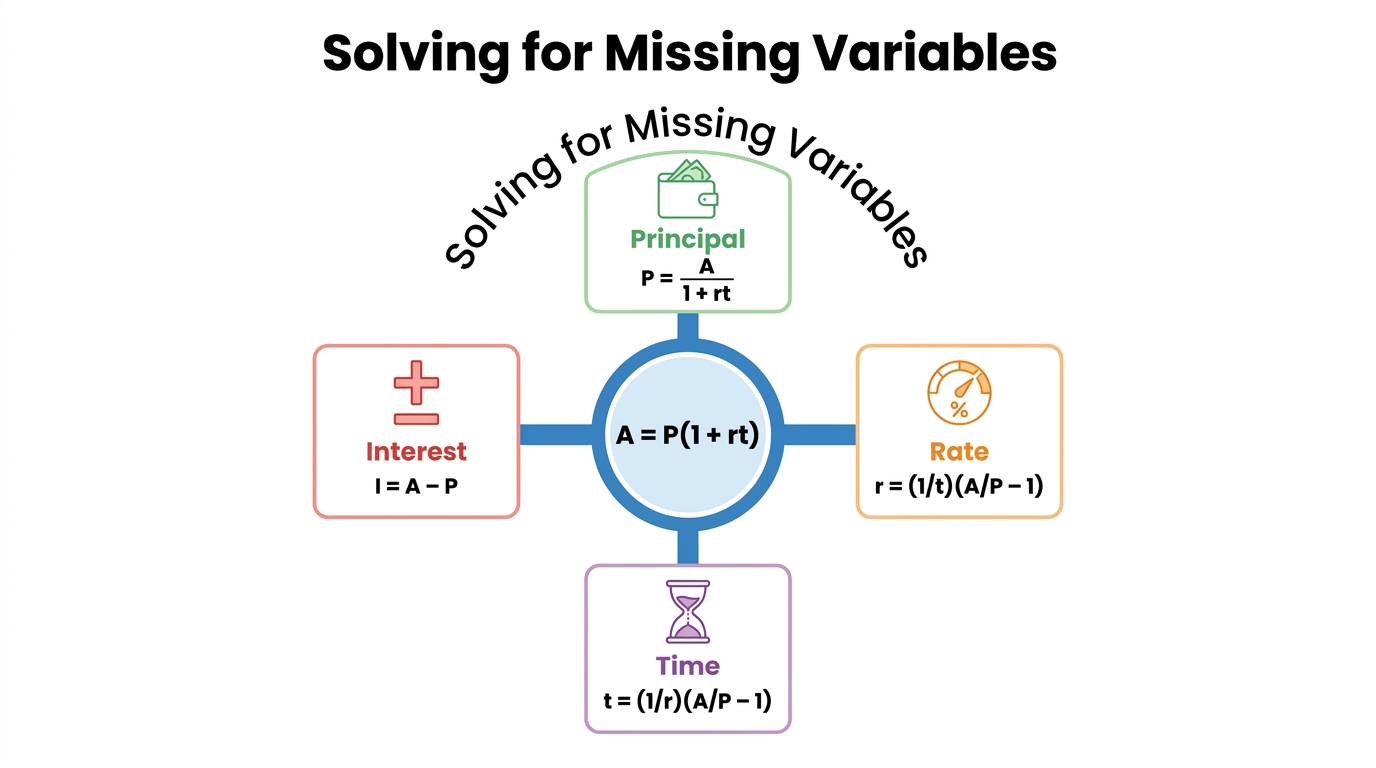
Here’s a quick reference you can bookmark for whenever you need to solve for something other than total interest.
P = A / (1 + rt) lets you calculate the starting principal needed to reach a target total amount.
r = (1/t)(A/P − 1) lets you calculate the annual interest rate needed to grow a starting amount into a target total within a set time.
t = (1/r)(A/P − 1) lets you calculate how long it’ll take to reach a target total at a known rate.
I = A − P lets you calculate the interest amount alone once you already know both the total and the principal.
Worked example: solving for the interest rate
Say you want to grow $22,000 into $26,800 over 4 years, and you need to know what rate would get you there. Using r = (1/t)(A/P − 1), you’d substitute in your known values.
That gives you r = (1/4)((26,800 / 22,000) − 1), which simplifies to (0.25)(1.218 − 1), or (0.25)(0.218). That works out to r = 0.0545. Multiply by 100 to convert to a percentage, and you land on 5.45%, meaning you’d need an annual simple interest rate of 5.45% to hit your $26,800 goal.
Simple interest vs. compound interest: which matters more?
Simple interest and compound interest differ in one key way, compound interest charges or earns “interest on interest,” while simple interest never does. That single difference can add up to a meaningful gap in your total costs or earnings, especially over longer terms.
Compound interest recalculates the balance at the end of every compounding period, folding the newly earned interest back into the principal before the next round of interest gets calculated. This creates accelerating growth rather than the flat, linear growth you get with simple interest.
Key differences at a glance
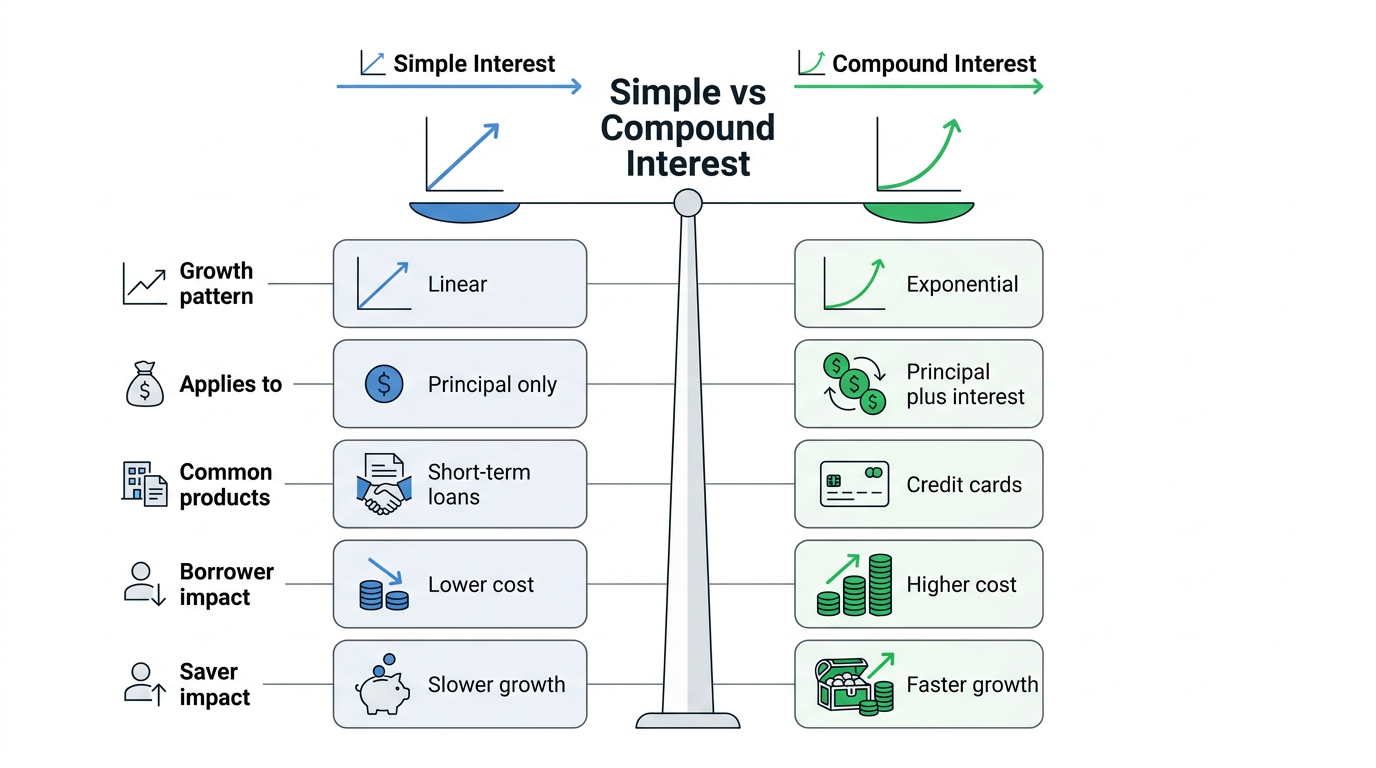
The table below breaks down how these two methods stack up against each other in practice.
| Feature | Simple interest | Compound interest |
|---|---|---|
| Growth pattern | Linear, constant rate | Exponential, accelerates over time |
| Applies to | Original principal only | Principal plus prior interest |
| Common products | Short-term loans, some bonds | Credit cards, most savings accounts |
| Borrower impact | Lower total cost | Higher total cost |
| Saver impact | Slower growth | Faster growth |
Side-by-side example: $10,000 loan over 5 years
Numbers make this difference much easier to feel than definitions alone. Take a $10,000 loan at 5% interest over 5 years, and compare both methods directly.
With simple interest, your total repayment lands at $12,500, made up of $10,000 principal and $2,500 interest. With interest compounded monthly instead, that total rises to $12,833.59, made up of the same $10,000 principal but $2,833.59 in interest. That’s a $333.59 difference on a fairly modest loan, and the gap only widens further with higher rates, longer terms, or more frequent compounding.
Which one benefits you?
Whether simple or compound interest works in your favor depends entirely on which side of the transaction you’re on. As a borrower, simple interest usually costs you less overall, since you’re never paying interest on interest you’ve already been charged.
As a saver or investor, compound interest usually works better, since your balance grows faster the longer you leave it untouched, a dynamic explored in a comparative analysis of pension fund growth models that contrasts simple and compound interest outcomes over time. Understanding this distinction before signing any loan agreement or opening any savings account can save you real money down the road.
Tip: Before signing any loan or savings agreement, ask whether the interest is simple or compound, and how often it compounds if applicable. That single question can change your total cost or return by a noticeable margin.
Verify your math with free calculators
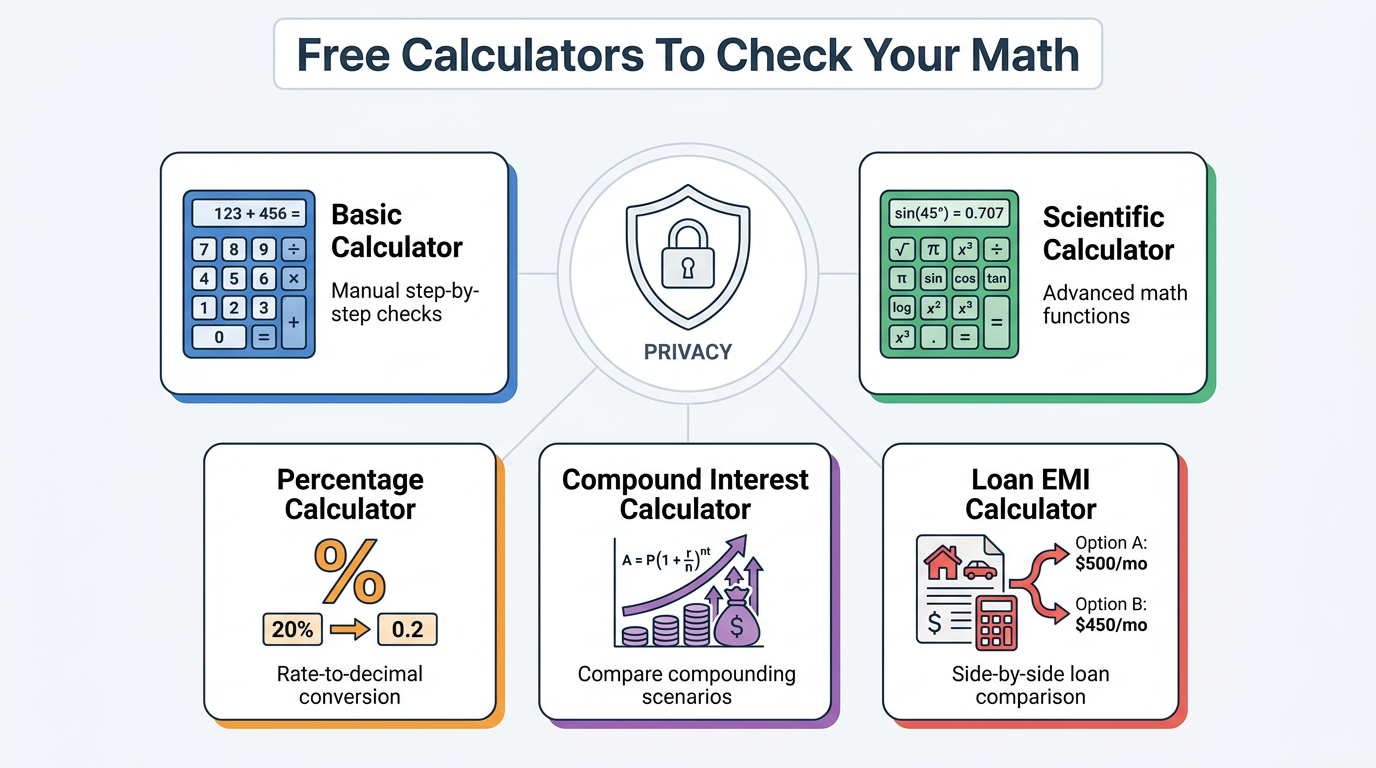
Verifying your simple interest math means running your numbers through a second, independent tool before making any financial decision based on them. This step catches small errors, like a misplaced decimal or a rate that wasn’t converted properly, before they turn into a wrong loan comparison or a bad savings estimate.
Tools Repository offers a Basic Calculator and a Scientific Calculator that work well for manually re-checking each step of I = P × r × t, plus a Percentage Calculator that handles the rate-to-decimal conversion cleanly. If you want to compare your simple interest results against a compounding scenario, its Compound Interest Calculator and Loan EMI Calculator make that side-by-side comparison quick and painless.
Every tool on the platform runs entirely in your browser, meaning your loan amounts, rates, and other financial details never get stored, tracked, or sent anywhere. That’s a meaningful difference from calculator sites that ask for an account or quietly log your inputs.
All calculators are free, with no sign-up or subscription required at any point.
Results are calculated directly on your device, so sensitive financial figures stay private.
Tools work across desktop, tablet, and mobile without needing any installation.
Keep in mind that these calculators are meant for quick estimates and learning purposes, not as a substitute for professional financial advice. For anything involving a significant loan, investment, or contract, it’s worth talking to a qualified financial advisor before making a final decision.
Frequently asked questions
Question: How do you calculate simple interest on a loan?
You apply the formula I = P × r × t, multiplying the loan’s principal by its annual rate (as a decimal) and by the loan term in years. If your term is given in months or days, convert it into years first by dividing by 12 or 365. This keeps your rate and time period in matching units.
Question: What is the difference between I = Prt and I = Prn?
I = Prt uses an annual interest rate paired with time expressed in years. I = Prn instead uses a periodic rate, like a monthly rate, paired with the number of periods (n) rather than years. Mixing these up, using an annual rate with a period count, will give you an incorrect result.
Question: Can simple interest change over the life of a loan?
No, the rate and the principal base stay fixed for the entire loan term under simple interest. The one exception involves savings accounts, where additional deposits or withdrawals change the effective principal being used, which then changes how much interest accrues going forward.
Question: What types of loans or accounts use simple interest?
Short-term loans, some fixed-coupon bonds, and certain short-term CDs commonly use simple interest because of its predictability, a linear growth model examined in comparative research on pension fund interest structures that contrasts it with compounding alternatives. Most everyday financial products people use daily, including credit cards and standard savings accounts, rely on compound interest instead, which behaves quite differently over time.
Question: How do I calculate simple interest for a partial year, like 3 months?
Divide 3 by 12 to get 0.25, which represents three months as a fraction of a year. Plug that 0.25 in as your value for t in the formula I = P × r × t, keeping your rate in its usual annual decimal form.
Question: Is a 360-day or 365-day year used for simple interest?
A 365-day year is the standard convention used for most simple interest calculations. A 360-day year sometimes shows up in commercial or banking contexts instead, so it’s worth double-checking your loan agreement or account terms to confirm which one applies to your situation.
The takeaway
Calculating simple interest really comes down to two formulas, I = P × r × t for interest alone, and A = P(1 + rt) when you need the total balance instead. Once you convert your rate to a decimal and your time period into years, the math itself is quick multiplication that anyone can do by hand or on a phone calculator.
Whether you’re a student working through a finance assignment, a freelancer comparing loan offers, or a small business owner planning around a short-term CD, these two formulas cover nearly every situation you’ll run into. Before locking in any financial decision, it’s worth running your numbers through a second source, and Tools Repository’s free, private calculators offer a fast way to confirm your math without giving up any personal data in the process.