
How to Calculate Student Loan Interest (Step by Step)

Alisha Anjum

Staring at your student loan statement and wondering how that interest number got calculated? You’re not alone, and the good news is the math behind it is simpler than it looks.
Student loan interest follows one basic formula that stays the same no matter how big your balance is. Once you know your annual rate, your balance, and how many days have passed since your last payment, you can figure out exactly how much interest you owe. This guide walks through how to calculate student loan interest using the exact three-step method lenders rely on, shows a full worked example with real numbers, and explains how your payments get split between fees, interest, and principal. You’ll also find tips on lowering your rate, using extra payments to save money, and letting a free calculator handle the math for you.
By the end, you’ll be able to check your servicer’s numbers yourself instead of just trusting the statement.
Key takeaways
- Student loans accrue interest daily, not through daily compounding, so you never pay interest on interest.
- The core formula is daily rate times balance times days equals the interest charged for that period.
- Your payment covers outstanding fees first, then interest, and only then reduces your principal.
- Extra payments made early in your loan term save the most money because your balance is highest then.
- Free online calculators, including tools built for privacy, can run these numbers instantly without any manual math.
Table of Contents
- What is daily interest and why does it matter?
- How do I calculate student loan interest step by step?
- How is my monthly payment applied to interest and principal?
- What affects your student loan interest rate?
- How can I use a calculator to skip the math?
- How do extra payments reduce total interest?
- The takeaway
- Frequently asked questions
- Does student loan interest compound daily?
- What happens to unpaid interest when it capitalizes?
- Do weekends or holidays affect daily interest accrual?
- How much interest will I pay over the life of my loan?
- Can I pay off interest before it’s due?
- Is a fixed or variable rate better for calculating interest?
What is daily interest and why does it matter?
Daily interest on a student loan means the same interest rate gets applied to your balance every single day, with no interest charged on interest that already accrued. This is different from compounding interest, where each day’s charge gets added to the balance and then earns its own interest the next day. Academic research on student loan repayment burdens shows that simple daily interest, rather than compounding, keeps the math predictable and, generally, cheaper for the borrower over time.
This distinction matters because it changes how you think about timing your payments and your extra contributions. A credit card that compounds daily punishes you for carrying a balance longer, since unpaid interest starts generating its own interest. Student loans don’t work that way, so every dollar you send toward principal has an immediate and lasting effect on your daily accrual, without any hidden penalty for the interest you’ve already paid.
How do I calculate student loan interest step by step?
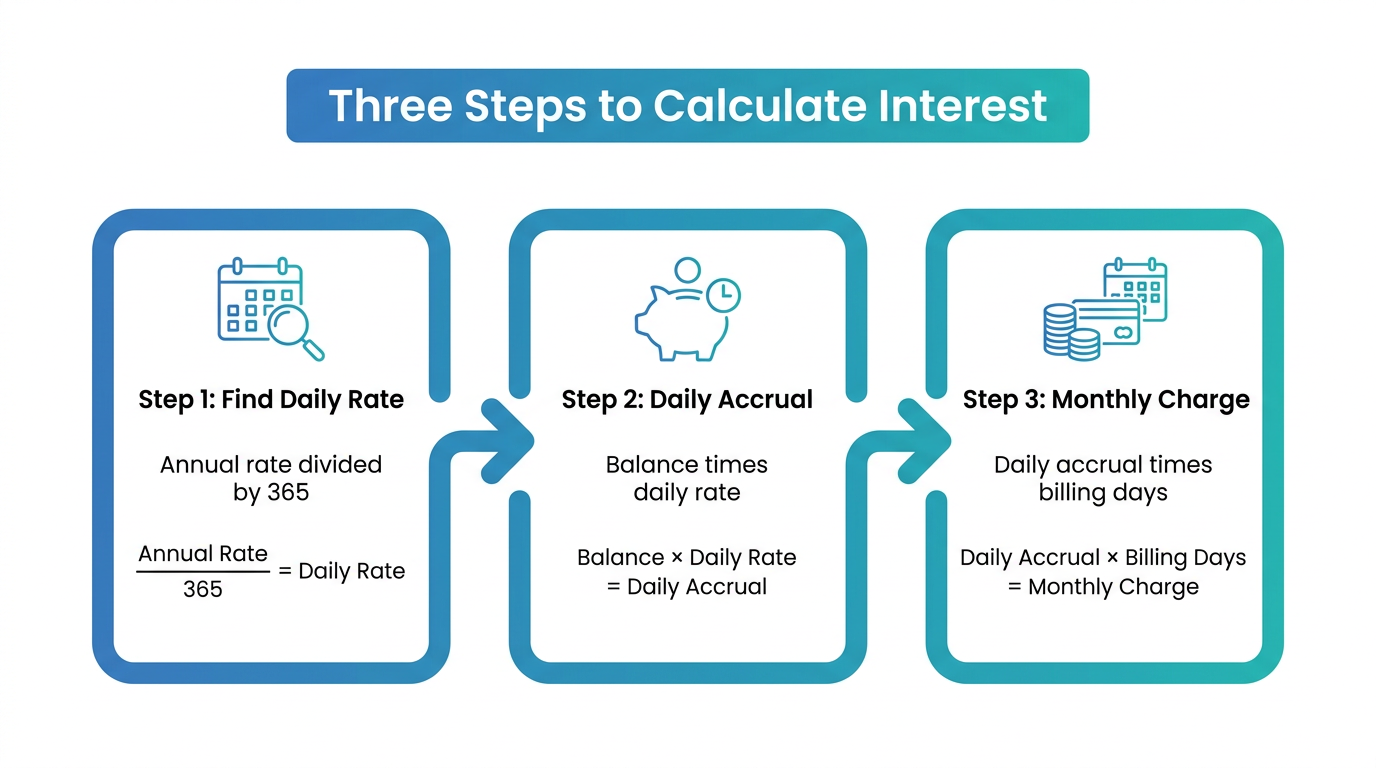
Calculating student loan interest comes down to three simple steps, each building on the last, using only your annual rate, your balance, and the number of days in your billing cycle. Say you borrow $27,000 at a 5.5% annual rate on a 10-year repayment plan with a monthly payment near $293. First, you turn the annual rate into a daily rate. Second, you apply that daily rate to your outstanding balance to find how much interest builds up in a single day. Third, you multiply that daily figure by the number of days in your billing period, usually around 30, to get your monthly interest charge. As you make payments and your balance drops, the same three steps produce a smaller interest number each cycle, since a lower balance always accrues less daily interest than a higher one. This is the exact process most loan servicers use behind the scenes, and walking through it yourself is the fastest way to confirm your statement is accurate.
Step 1: find your daily interest rate
You find your daily interest rate by dividing your annual rate by 365. For a 5.5% loan, that’s 0.055 divided by 365, which equals 0.00015, or about 0.015% per day. Most lenders use 365 days even during leap years, so this number stays fixed for fixed-rate loans throughout your entire repayment term.
Step 2: calculate your daily interest accrual
Next, multiply your outstanding balance by that daily rate to see how much interest builds up in one day. On a $27,000 balance at 0.00015, that’s $27,000 times 0.00015, which equals $4.05 per day. This figure isn’t fixed forever, though; it shrinks every time your principal balance goes down, since a smaller balance always produces a smaller daily charge.
Step 3: calculate your monthly interest charge
To get your monthly interest, multiply your daily accrual by the number of days in your billing period. Using $4.05 a day across a standard 30-day month gives you $121.50 in interest for that cycle. Keep in mind some servicers count exact calendar days between payments instead of a flat 30, so your own number might shift slightly depending on your billing dates.
Putting it together: a full example
Bringing all three steps together on the $27,000 loan at 5.5% over 10 years shows exactly where your $293 payment goes each month:
- Month one: $121.50 covers interest, and the remaining $171.50 reduces your principal.
- Later months: as your balance drops, your daily interest shrinks, and a larger share of each $293 payment starts chipping away at principal instead of interest.
That’s exactly how you want the split to move over time.
How is my monthly payment applied to interest and principal?
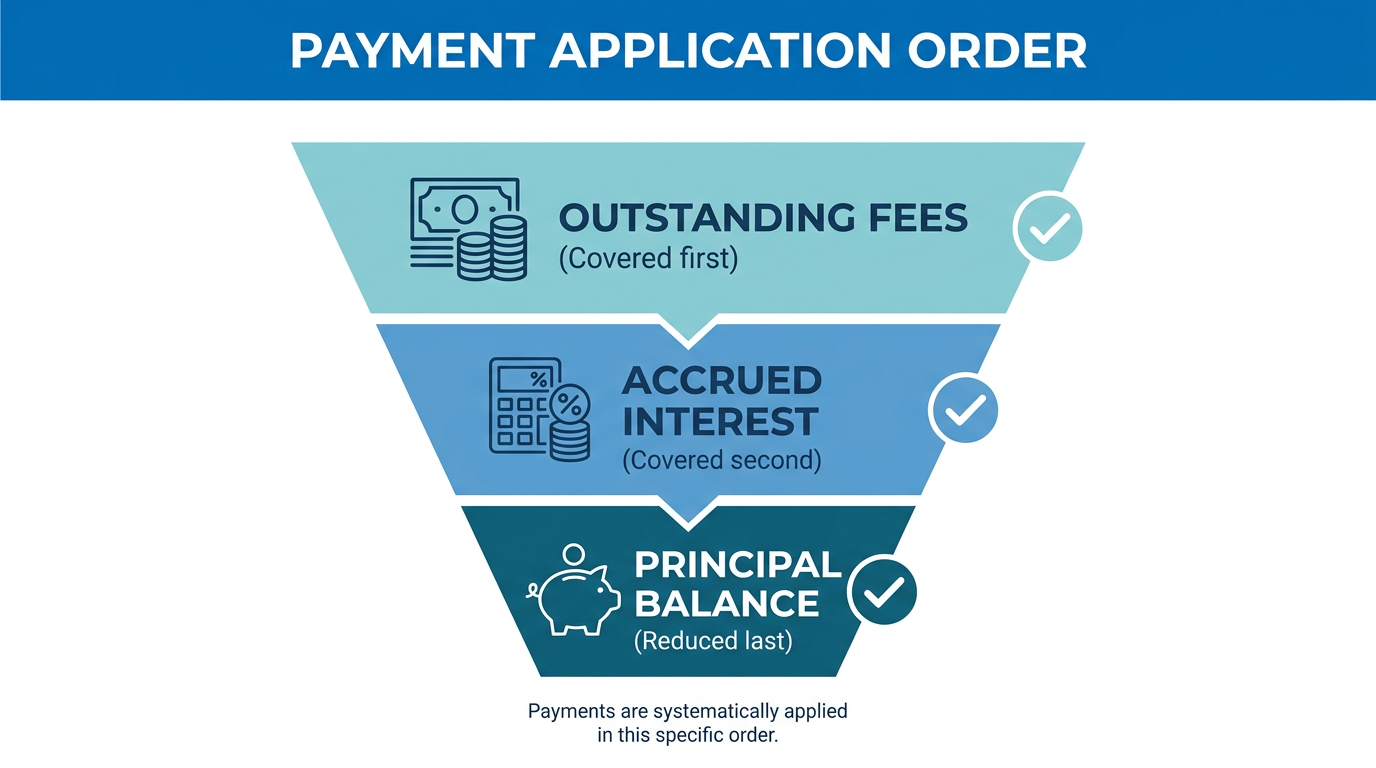
Your monthly student loan payment gets applied in a fixed order, starting with any outstanding fees, then moving to accrued interest, and only then reducing your principal balance. This hierarchy means that until every cent of interest for the period is covered, none of your payment actually lowers what you originally borrowed. It’s a standard practice across nearly all federal and private student loan servicers, so understanding it helps explain why your balance sometimes seems to drop slower than expected in the early mortgage payoff calculator.
Using the earlier example, a $293 payment with no outstanding fees would send $121.50 toward interest and $171.50 toward principal. Because this split changes every month as your balance falls, paying extra toward principal has a compounding benefit of its own. Every additional dollar applied to principal shrinks the balance your daily interest is calculated against, which lowers next month’s interest charge immediately and permanently for the rest of the loan.
What affects your student loan interest rate?

Your student loan interest rate depends mainly on whether you have a federal or private loan, and for private loans, on your personal credit profile. Federal student loans carry fixed rates set annually by Congress, and official government data on income contingent repayment plans and interest rate calculations confirms every borrower with the same loan type in the same year pays an identical rate regardless of income or credit history. Private lenders, on the other hand, set rates based on the borrower’s or cosigner’s credit score, income, and overall financial picture, which is why two people borrowing the same amount can end up with very different rates.
Several practical steps can help you land a lower rate on a private loan or when refinancing:
- Enroll in automatic payments. Many lenders shave 0.25% or more off your rate for this, a discount known as an autopay reduction.
- Add a cosigner with strong credit, which can qualify you for better terms than you’d get alone.
- Shop quotes from multiple lenders so you can compare offers before committing.
- Improve your own credit score by paying down other debt and staying current on bills, which tends to pay off with better rates over time.
How can I use a calculator to skip the math?

A student loan calculator lets you skip manual arithmetic entirely by entering just three numbers, your loan amount, your annual interest rate, and your loan term, to get an instant monthly payment, total interest, and full amortization breakdown. This is especially useful for comparing different scenarios quickly, like what happens if you choose a 10-year term instead of a 15-year one, without redoing the three-step formula by hand every time.
Tools Repository offers a free student loan calculator alongside more than 100 other browser-based utilities, and it runs entirely on your device with no login and no data sent to a server. That privacy-first setup matters if you’d rather not create an account just to run a quick financial estimate. Since the tool works instantly in your browser, you can plug in different rates or terms side by side and see the total interest difference in seconds, which makes it easier to decide between loan offers before you sign anything.
How do extra payments reduce total interest?
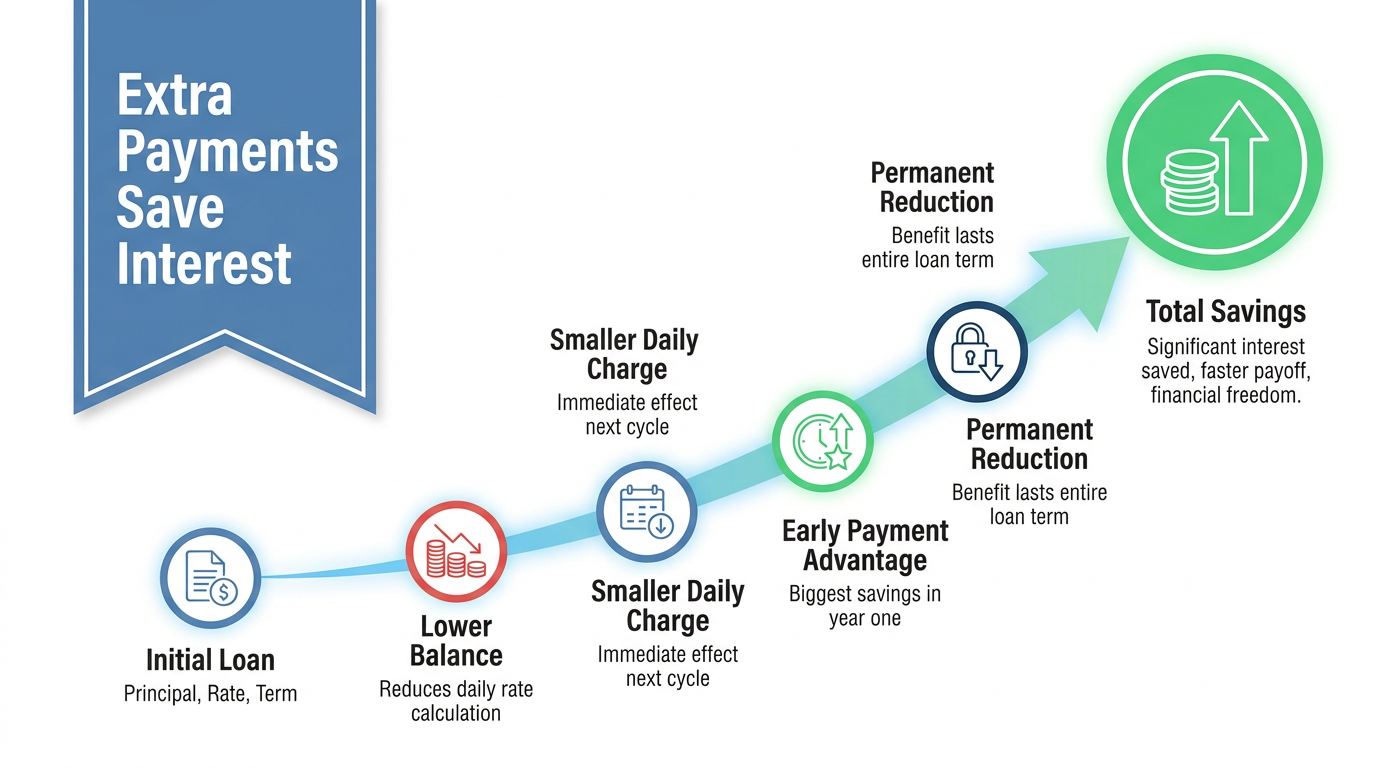
Extra payments reduce total interest because they lower your outstanding balance faster, which directly shrinks the daily interest calculated on that balance going forward. Since the formula in step two of the calculation multiplies your balance by the daily rate, any reduction in balance immediately lowers every future daily charge for the rest of the loan, not just for one billing cycle.
Even small extra payments add up meaningfully over a long loan term. Committing an extra $20 a month on a 10-year loan adds $2,400 in additional principal payments alone, and because that money stops accruing interest the moment it’s applied, the savings goal calculator from avoided interest often end up higher than the extra amount you paid. Applying a bonus, tax refund, or other unexpected cash directly to principal early in your loan term tends to produce the biggest savings of all.
The takeaway
Calculating student loan interest really comes down to three repeatable steps: turning your annual rate into a daily rate, applying that rate to your balance, and scaling it up to a monthly charge, combined with knowing that your payment always covers fees and interest before it touches principal. Once you understand that relationship, it’s much easier to see why extra payments made early in your loan save more than the same payment made later, and why a lower rate or shorter term can change your total cost dramatically.
If you’d rather not run these numbers by hand every time you consider a new rate or repayment plan, a free calculator like the one on Tools Repository can confirm your figures in seconds without asking for any personal information. From there, it’s worth exploring the platform’s other free calculators and utilities, since the same privacy-first, no-login approach applies across every tool on the site.
Frequently asked questions
Does student loan interest compound daily?
No, standard student loans accrue simple daily interest rather than compounding daily, meaning you don’t pay interest on interest that has already accrued. The main exception is capitalized interest, which happens after periods like deferment or forbearance, when unpaid interest gets added to your principal balance and starts accruing interest itself from that point forward.
What happens to unpaid interest when it capitalizes?
Capitalization means any unpaid interest gets added directly to your principal balance, creating a new, higher balance going forward. Since future daily interest is calculated on this larger balance, capitalization raises the total interest you’ll pay over the remaining life of the loan, even if your interest rate itself never changes.
Do weekends or holidays affect daily interest accrual?
No, student loan interest accrues on every calendar day, including weekends and holidays, since the daily rate applies continuously regardless of business days. This is different from some financial processes that only count business days, so your interest calculation should always use the full number of calendar days between payments.
How much interest will I pay over the life of my loan?
Your total interest depends on your interest rate, your loan term, and how consistently you make payments or add extra principal along the way. Because these variables interact differently for every borrower, the most accurate way to get your total is entering your specific auto loan calculator, and term into a free calculator rather than relying on a general estimate.
Can I pay off interest before it’s due?
Yes, making interest-only payments during school or during a grace period prevents that interest from capitalizing once repayment officially begins. This keeps your original principal balance intact at the start of repayment, which can meaningfully lower the total interest you pay across the full loan term.
Is a fixed or variable rate better for calculating interest?
Fixed rates are easier to calculate and plan around because your daily rate never changes for the life of the loan, unlike variable rates, which adjust periodically based on market conditions. With a variable-rate loan, you need to recalculate your daily rate every time the rate resets, making your monthly interest less predictable from year to year.