
What Is a Simple Interest Formula? (I = Prt Explained)

Alisha Anjum

Trying to figure out how much interest a loan or savings account will really cost or earn can feel confusing, especially when every bank and calculator seems to use different numbers. Interest math doesn’t have to be complicated. So what is a simple interest formula? It’s a plain equation, written as I = Prt, that calculates interest based only on your original principal amount, with no compounding involved at all.
Many people mix up simple interest with compound interest, or don’t know how to plug real numbers into the equation. That confusion can lead to bad assumptions about what a loan actually costs or what a deposit will actually earn over time.
This guide breaks the simple interest formula down in plain language, then walks through real examples using loans and savings accounts. You’ll see how to rearrange the formula to solve for principal or time, how simple interest stacks up against compound interest, and where you’re likely to run into it in everyday finance. We’ll also show you how a free tool from Tools Repository can check your math in seconds.
Key takeaways
The simple interest formula is I = P × r × t, where P is the principal, r is the annual rate, and t is time in years.
To find the full balance rather than just the interest, use A = P(1 + rt).
Simple interest grows in a straight line, unlike compound interest, which accelerates over time.
Auto loans, student loans, short-term personal loans, and many mortgages calculate interest this way.
You can rearrange the formula to solve for principal or time when planning a savings goal or loan payoff.
Table of Contents
- What is the simple interest formula?
- How do you calculate simple interest step by step?
- Simple interest vs. compound interest: what’s the real difference?
- Where is simple interest used in everyday finance?
- Skip the manual math with a free calculator
- The takeaway
- Frequently asked questions
What is the simple interest formula?
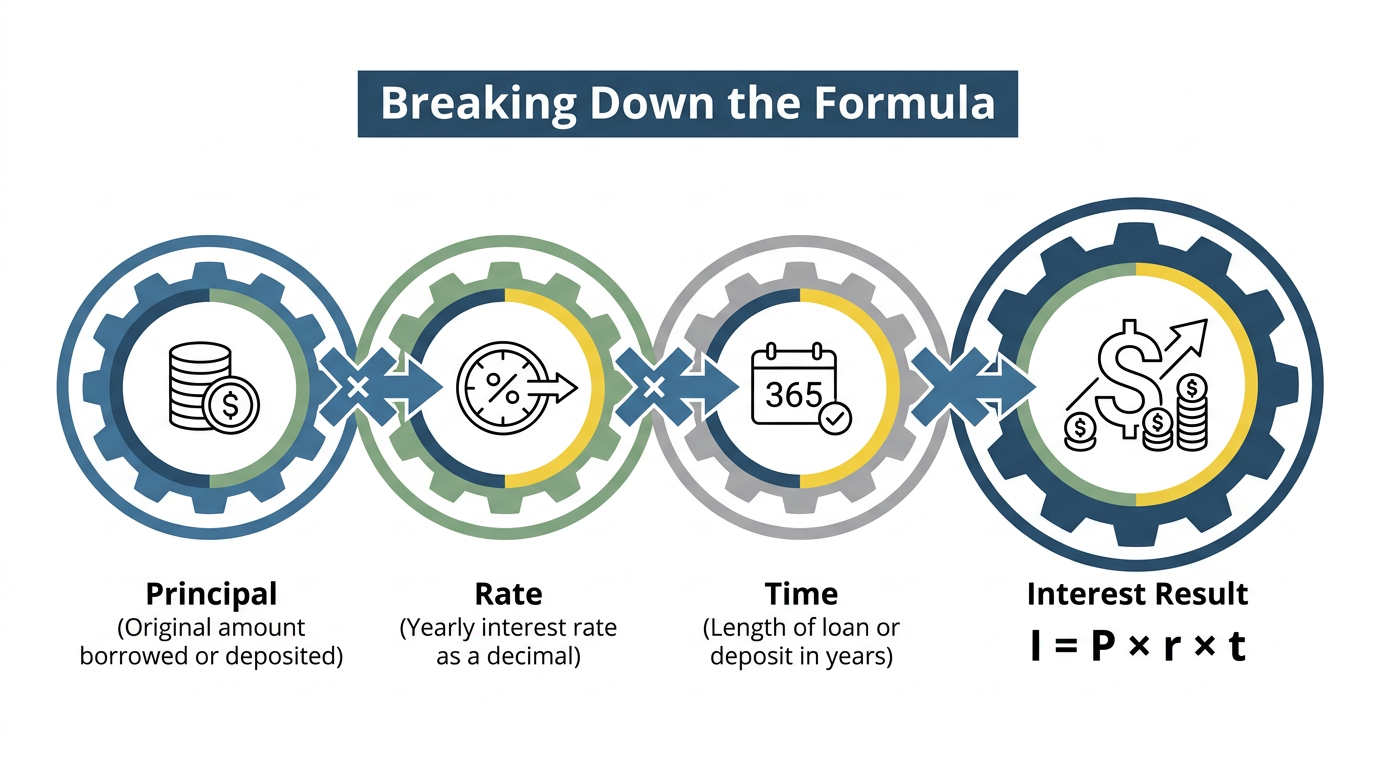
The simple interest formula is I = P × r × t, a calculation that finds interest owed or earned using only the original principal, never any interest that built up before it. This is what makes simple interest so predictable compared to other interest calculations. In the formula, I stands for the interest amount, P stands for principal, r stands for the yearly interest rate written as a decimal, and t stands for the time period, usually measured in years. Because none of these variables change mid-calculation based on prior interest, the math stays simple enough to do on paper or in your head, which is exactly why so many everyday loans and short-term deposits still rely on it.
Breaking down P, r, and t
Each letter in the formula stands for something concrete you can pull straight from a loan agreement or account statement:
P is the principal, the actual dollar amount borrowed or deposited before any interest gets added.
r is the yearly percentage rate converted into a decimal, so 6% becomes 0.06 in the equation.
t is the length of the loan or deposit in years, though it can be written as a fraction, like 0.5 for six months.
Finding the total amount owed or earned
Knowing the interest alone only tells half the story, so most people also want the total amount, labeled A, sitting in an account or owed on a loan. That total comes from adding interest back to the principal, A = P + I, which simplifies to A = P(1 + rt) once you substitute in the original formula. This version saves a step whenever you need the final balance directly, rather than calculating interest first and adding it separately afterward.
How do you calculate simple interest step by step?
Calculating simple interest step by step means plugging your principal, rate, and time straight into I = Prt, a method outlined in detail in this simple interest applications guide, then adding that result back to the principal if you need the full balance. The process stays the same whether you’re checking a savings account, a car loan, or a student loan repayment, which is part of what makes this formula so approachable for anyone without a finance background. Once you see a few worked examples side by side, the pattern becomes obvious, and you’ll be able to run your own numbers on any loan offer or deposit account within a minute or two.
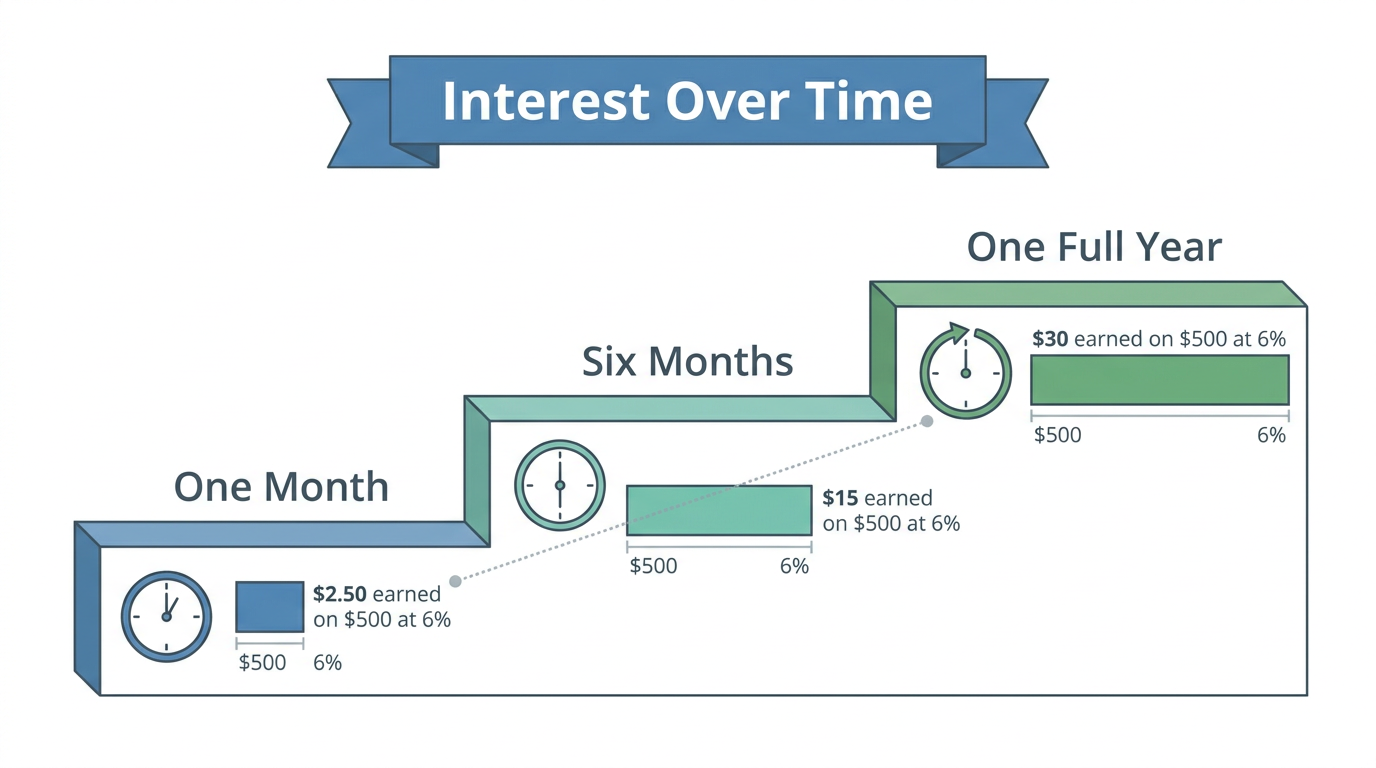
Example: Interest over different time periods
Say you invest $500 at a 6% simple interest rate.
Over one month: I = (500)(0.06)(1/12) = $2.50
Over six months: I = (500)(0.06)(6/12) = $15
Over a full year: I = (500)(0.06)(1) = $30
This shows how interest grows in a straight, proportional line as time passes.
Example: Savings account and loan repayment
Suppose someone deposits $200 into a savings account at a 12% simple interest rate. Using I = Prt, that’s I = (0.12)(200)(1), or $24 in interest for the year. Add that to the principal and the account holds $224 by year’s end, a quick example of A = P(1 + rt) in action.
Now picture an $18,000 student loan carrying a 6% rate over a three-year term. The interest comes out to I = $18,000 × 0.06 × 3, or $3,240. Combined with the original principal, the borrower owes $21,240 by the time the loan term ends.
Solving for principal or time
The same formula rearranges easily whenever you know the total amount but need to find principal or time instead.
To solve for principal, use P = A / (1 + rt), which tells you how much to deposit today to hit a future savings goal.
To solve for time, use t = ((A/P) − 1) / r, which is handy for figuring out how many years it will take an investment or loan to reach a specific balance.
Simple interest vs. compound interest: what’s the real difference?
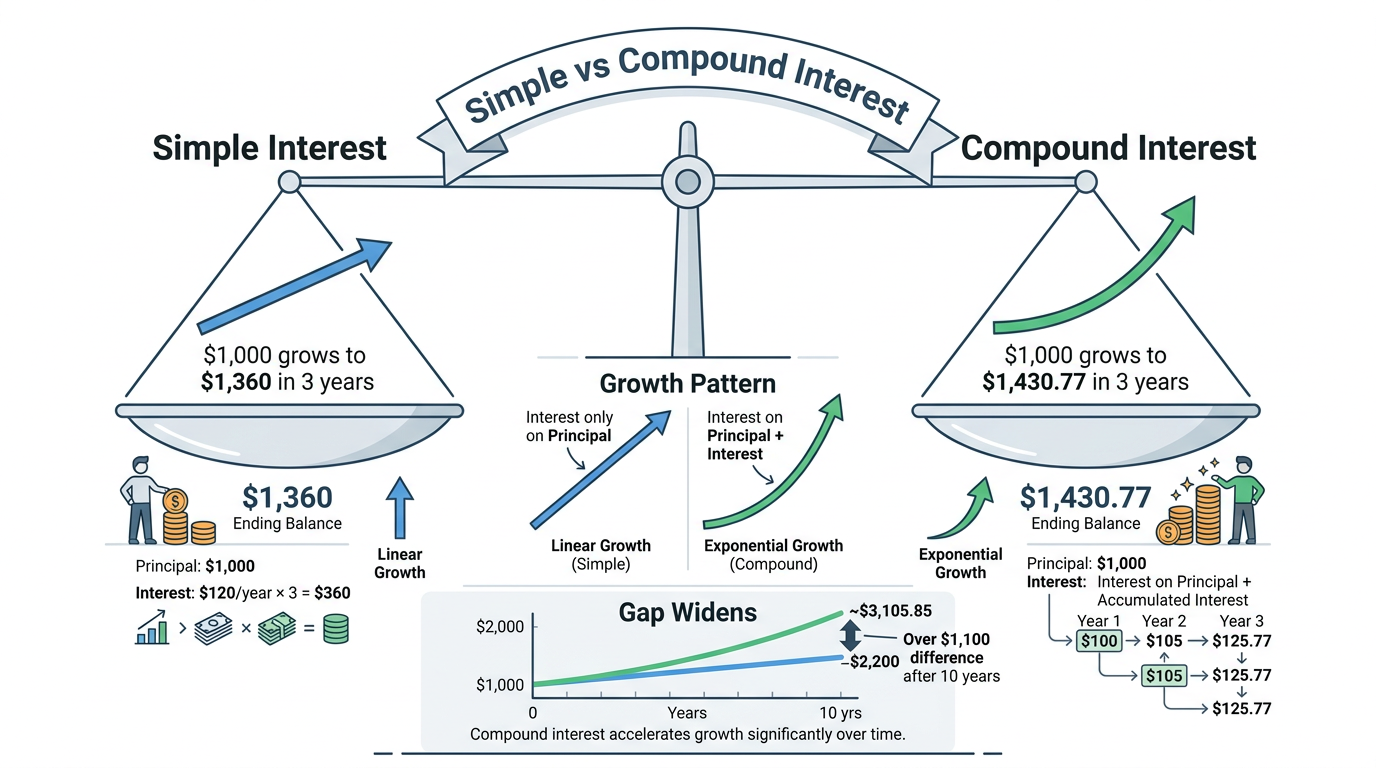
The real difference between simple interest and compound interest comes down to whether interest is charged only on the original principal or on principal plus previously earned interest. Simple interest keeps the calculation flat and predictable, since the same principal gets used every single period. Compound interest, on the other hand, adds each period’s interest back into the balance, so future interest calculations grow from a larger number every time, creating what’s often called a snowball effect. Consider Sally and Ann, who each invest $1,000 at 12% for three years. Sally, earning simple interest, ends up with $1,360, while Ann, earning interest compounded monthly, ends up with $1,430.77, a $70.77 gap that widens to over $1,100 after ten years.
Comparison table: simple vs. compound
The table below lays out the practical differences side by side so you can see at a glance which method applies to your situation.
| Feature | Simple interest | Compound interest |
|---|---|---|
| Calculation basis | Original principal only | Principal plus prior interest |
| Growth pattern | Linear, constant rate | Exponential, accelerating rate |
| Typical products | Auto loans, student loans | Savings accounts, credit cards |
| Who benefits most | Borrowers pay less | Savers earn more |
Where is simple interest used in everyday finance?
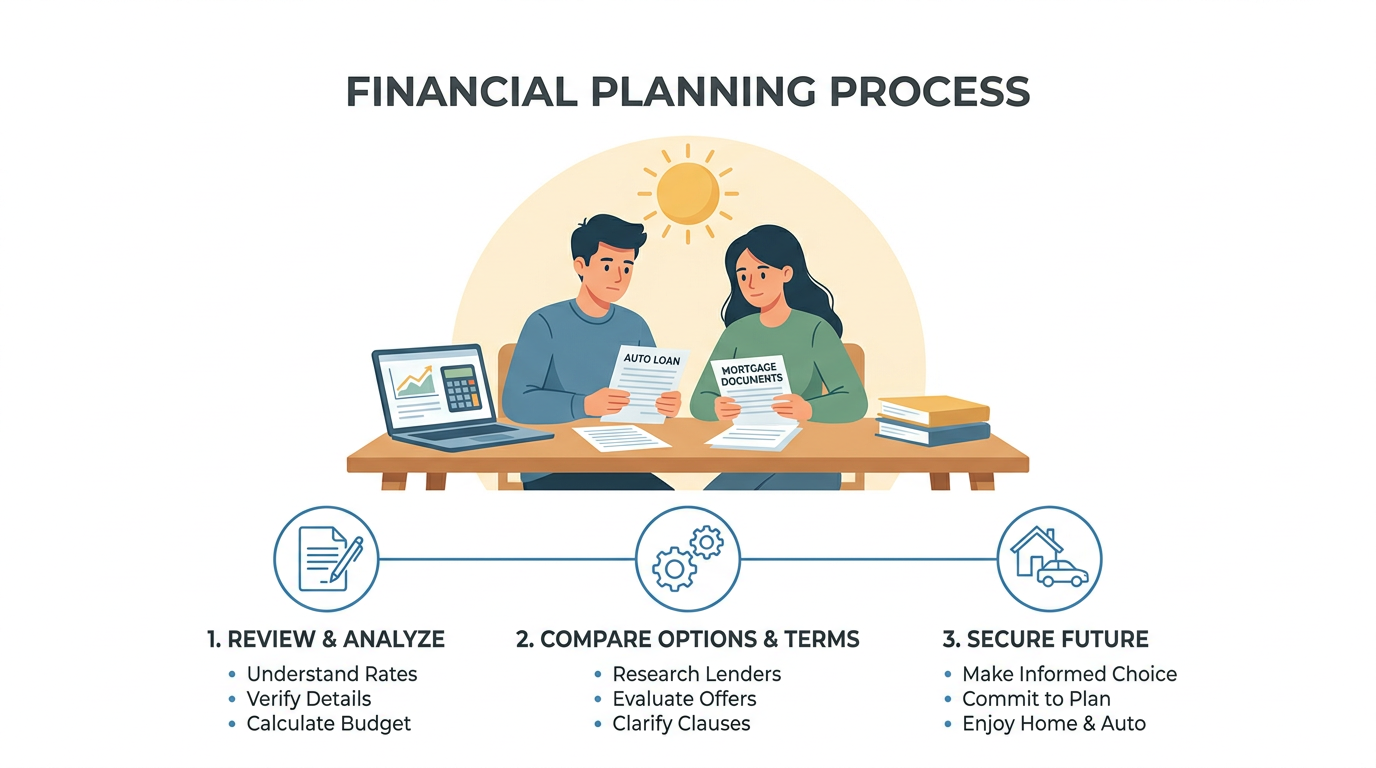
Simple interest shows up across several common financial products that most people encounter at some point. Auto loans, short-term personal loans, many student loans, and a good number of mortgages all calculate interest this way, which is part of why the formula is worth knowing even if you never touch a spreadsheet.
One practical upside is that borrowers can often reduce total interest owed by paying extra toward the principal balance. Since interest is calculated fresh each period based only on the outstanding principal, a smaller balance means smaller future interest charges, and strategies like biweekly mortgage payments can shave real money off a loan over its full term.
Skip the manual math with a free calculator

Running the simple interest formula by hand works fine for a single loan or deposit, but checking several scenarios quickly gets tedious. Tools Repository offers a browser-based calculator built for exactly this kind of quick math, letting you plug in principal, rate, and time to see interest and total balance instantly without opening a spreadsheet.
Since the tool runs entirely in your browser, none of your numbers get sent anywhere or stored on a server. There’s no sign-up, no subscription, and no cost involved, which fits well for students comparing loan offers or freelancers checking a client payment plan on the fly.
The takeaway
Two formulas do almost all the work here. I = Prt gives you the interest earned or owed, and A = P(1 + rt) gives you the full balance once that interest gets added back to the principal. Both stay simple because the principal used in the math never changes, no matter how many periods pass.
Whether you’re comparing an auto loan, sizing up a student loan repayment, or projecting a savings account balance, these two equations cover most of what you’ll ever need. If you’d rather skip the manual plugging and checking, a free calculator like the one on Tools Repository can confirm your numbers in seconds, no strings attached.
Frequently asked questions
Question: What is the difference between simple interest and daily simple interest?
Daily simple interest accrues every single day based on the current outstanding balance, rather than being calculated only up to a fixed due date. The balance also drops on the exact day a payment is received, not on a scheduled date, which matters for early or late payments.
Question: Do mortgages use simple interest or compound interest?
Most amortized mortgages in the U.S. technically use simple interest calculations. They can still feel like compound interest, though, since falling principal balances let more of each payment go toward principal over time, creating a similar snowball effect on paydown speed.
Question: How do I lower the total interest I pay on a simple interest loan?
Making extra payments directly toward the principal is the most reliable way to cut total interest owed. Since interest recalculates from the current balance each period, a smaller principal immediately reduces future charges, and switching to biweekly payments can shorten the loan term further.
Question: Can the simple interest formula be used for savings accounts?
Yes, some savings accounts and certificates of deposit pay simple interest rather than compound interest. The same formula, I = Prt, applies whether the money is being borrowed or deposited, so the math works identically in both directions.
Question: What happens if I make a partial payment on a simple interest loan?
A partial payment is applied to any interest that has already accrued first, before touching the principal balance. Only the amount left over after covering that accrued interest goes toward reducing what you actually owe on the loan.